Accounting Firm in Dubai — Tax, VAT & Audit Services UAE | Al Burhan

UAE Small Business Relief Extended to 2029: Eligibility, Rules and Compliance Guide

Introduction
On August 7, 2026, the UAE Ministry of Finance confirmed something a lot of small business owners had been quietly anxious about: Ministerial Decision No. 131 extends Small Business Relief through tax periods ending on or before December 31, 2029, three years past the original 2026 cutoff.
If you run a small business or start-up in the UAE, this is the kind of update worth actually understanding rather than skimming, because the value of this extension depends entirely on knowing who qualifies, who doesn’t, and where the rule has edges that aren’t obvious at first glance.
What Is Small Business Relief Under UAE Corporate Tax?
Small Business Relief is a provision under UAE Corporate Tax Law that lets an eligible resident taxable person elect to be treated as having no taxable income for a given tax period. If you qualify and choose to claim it, you owe no Corporate Tax for that period, and your return becomes noticeably simpler to prepare.
It was originally introduced under Ministerial Decision No. 73 of 2023, applying to tax periods beginning on or after June 1, 2023. From the start, it was designed as a compliance simplification tool for genuinely small businesses and start-ups, not a permanent exemption from the tax system. You remain a taxable person either way, still required to register and file.
There’s a trade-off worth knowing before you assume electing is always the right move. If you elect Small Business Relief for a period, you can’t accrue a tax loss for that same period, and any disallowed net interest expenditure doesn’t accumulate either.
Not electing preserves both of those. For a business that’s genuinely loss-making in a given year, or carrying interest expenditure it expects to need later, that carry-forward value can matter more than the simplification the relief offers. It’s a decision worth making deliberately rather than defaulting into.
Small Business Relief Extension UAE: What Changed for 2029
The mechanics of the extension are straightforward, even if the announcement itself came with a fair amount of relief attached (no pun intended) for business owners who’d been budgeting for the relief to disappear.
Ministerial Decision No. 131 of 2026 amended the earlier decision to push the availability window from tax periods ending on or before December 31, 2026, out to tax periods ending on or before December 31, 2029.
That’s the entire substance of the change: three additional years during which eligible businesses can keep claiming the relief.
What stayed the same matters just as much. The AED 3 million annual revenue threshold set under Ministerial Decision No. 73 of 2023 is unchanged. Nothing about who qualifies shifted, only how long the option stays on the table.
Businesses that were already tracking toward the threshold don’t get a new, higher bar to plan around, and businesses comfortably under it don’t need to reassess their position because of this update alone.
Small Business Relief Eligibility Criteria: Revenue Threshold Explained
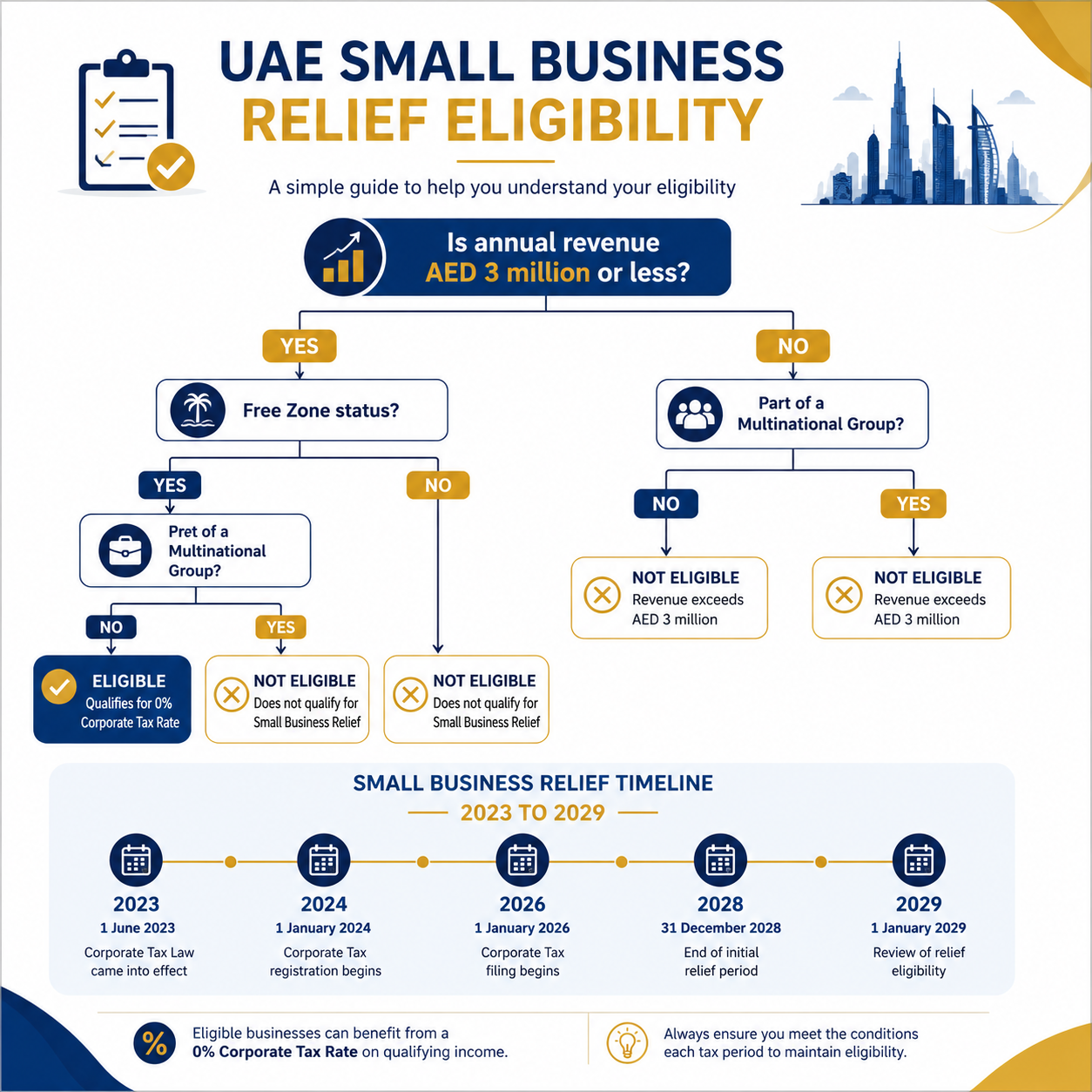
The core rule is that a UAE Resident Person with revenue of AED 3 million or less, roughly $816,880, may elect for Small Business Relief, subject to the other conditions covered below. The election has to be made in the Corporate Tax return itself; it isn’t automatic just because your revenue happens to sit under the line.
The threshold is measured on revenue, not profit, which trips up more businesses than you’d expect. Revenue is the gross amount coming in during the tax period under accepted accounting standards, and it isn’t reduced by expenses.
A business earning AED 2.8 million against AED 2.6 million in costs, leaving a thin margin, is still under the threshold and can qualify. A business that brought in AED 3.2 million but posted an accounting loss because expenses ran higher still exceeds the threshold and doesn’t qualify, regardless of profitability. Being unprofitable buys you no exception here.
There’s also a look-back element that’s easy to miss. Eligibility isn’t only about the current period; it’s tested against every relevant tax period going back to June 1, 2023. If revenue exceeded AED 3 million in even one earlier period, the relief becomes unavailable from that point forward permanently, even if revenue later drops back under the threshold.
A business earning AED 2.4 million, then AED 3.2 million, then AED 2.1 million across three consecutive years can only claim the relief in the first year. The second year’s breach closes the door for good, regardless of what the third year looks like.
Small Business Relief Disqualification Conditions: Who Doesn’t Qualify
Meeting the revenue threshold is necessary but not sufficient. Two categories are excluded regardless of how low their revenue is.
Qualifying Free Zone Persons don’t qualify. Free zone businesses generally sit under a separate Corporate Tax regime taxed at 0% on qualifying income, and that regime and Small Business Relief don’t overlap.
This is a common point of confusion, since being located in a free zone doesn’t automatically mean exclusion; it’s Qualifying Free Zone Person status specifically that disqualifies a business.
A free zone entity that doesn’t hold that particular status may still be eligible as a resident person if it meets the revenue and other conditions, so confirming actual tax status matters more than assuming based on trade license type.
The second exclusion applies to any business that’s a member of a Multinational Enterprise Group with consolidated global revenue exceeding AED 3.15 billion.
This targets larger international corporate structures and is unlikely to affect a genuinely independent small business, but it’s relevant for any UAE entity sitting inside a bigger group.
There’s also an anti-abuse rule worth understanding in concrete terms. If a single business is artificially split into multiple licenses mainly to keep each entity’s revenue under AED 3 million, the FTA can disregard that structure and treat it as an attempt to gain an improper tax advantage.
This shows up in practice as one trading operation divided into two or three separate licenses, sometimes registered to different family members, while functionally sharing staff, premises, and customers. That pattern is exactly what the anti-abuse provision targets.
Why the Corporate Tax Relief for Small Businesses UAE Matters Now
The financial impact isn’t trivial. The extension has been estimated to save eligible small business owners around $6,800 per year, on top of the administrative relief of not running a full Corporate Tax computation.
The timing matters too. This relief had been set to expire at the end of 2026, and plenty of business owners were quietly budgeting for the added complexity and cost that would bring. Extending it to 2029 removes that near-term pressure at a moment when rising operational costs and broader economic uncertainty are already squeezing margins for a lot of UAE SMEs.
For businesses that make up the vast majority of the UAE’s private sector, three more years of simplified compliance is a meaningful amount of breathing room, not just a technical footnote.
Small Business Relief vs Corporate Tax Exemption: Should You Elect?
It’s worth being precise about what this relief is not. It isn’t a Corporate Tax exemption, and electing it doesn’t remove you from the Corporate Tax system. It’s a simplified compliance election available for a given period, provided you meet the conditions and choose to claim it. You remain a taxable person throughout, with all the registration and filing obligations that come with that status.
Whether to elect isn’t always an obvious yes just because you’re under the threshold. A few situations where it makes sense to think twice before electing:
- You expect to post a loss for the period and want to preserve the ability to carry that loss forward against future profits
- You’re carrying disallowed net interest expenditure from a prior period that you’d want to keep available
- You’re planning a group restructuring, asset transfer, or transaction that would rely on Business Restructuring Relief or Qualifying Group Relief, since electing Small Business Relief for a period blocks access to those other reliefs in that same period
Two businesses with identical revenue can reasonably land on opposite decisions here, depending entirely on what else is happening in their finances that year. The relief being available doesn’t mean it’s automatically the better choice.
UAE Small Business Relief Compliance and Tax Return Filing Requirements
None of the obligations that come with being a taxable person disappear just because you’re claiming the relief. Registration for Corporate Tax within the applicable deadlines is still required.
A return still needs to be filed for every relevant tax period, generally within nine months of that period ending, even in a year where the relief brings your Corporate Tax liability to zero. And revenue, invoices, bank records, and reconciliations still need to be retained, generally for seven years, in case the FTA wants to verify the eligibility being claimed.
This is where clean bookkeeping stops being optional. The revenue test that determines eligibility depends entirely on accurate, well-organized financial records, and that dependency only grows once you factor in the look-back rule, since a business needs its historical revenue figures on hand and defensible, not just its current period’s numbers.
Accounting and bookkeeping support built around Corporate Tax compliance from day one makes both the eligibility check and the eventual filing considerably less stressful.
It’s also worth remembering that Small Business Relief and VAT sit in entirely separate parts of UAE tax law. VAT registration becomes mandatory once taxable supplies and imports exceed
AED 375,000 in a rolling 12-month period, a far lower bar than the AED 3 million Corporate Tax threshold. A business comfortably eligible for Small Business Relief can still be well within mandatory VAT registration territory and have separate filing obligations to manage under VAT compliance requirements that run on their own timeline.
FAQs: Small Business Relief Election, Documentation and Renewal
What is the UAE Small Business Relief revenue threshold?
AED 3 million or less in annual revenue, tested against the current tax period and every relevant prior period since June 1, 2023.
Is electing for Small Business Relief mandatory?
No. It has to be actively elected in the Corporate Tax return for each relevant period. Simply staying under the threshold doesn’t apply it automatically, and in some circumstances not electing may actually be the better choice.
Do I need to reapply for Small Business Relief each year?
Yes, in the sense that eligibility and the election both need to be confirmed and made fresh in each period’s return. It isn’t a one-time application that carries forward on its own; you need to remain under the threshold in every relevant period, and choose to elect it, each time.
What happens when the relief period ends in 2029?
Tax periods ending after December 31, 2029 would fall outside the current extension, meaning businesses would file under standard Corporate Tax rules from that point unless a further extension is announced closer to that date. Businesses should treat 2029 as a planning horizon rather than an assumption that relief continues indefinitely.
Related Reading
Getting Professional Guidance on Small Business Relief Eligibility
The 2029 extension is genuinely good news, but the benefit only holds up if the rules are applied correctly year over year, particularly given how permanently the look-back provision can shut the door after a single high-revenue period. Al Burhan Accounting and Taxation can review your revenue history against the eligibility conditions, help weigh whether electing makes sense for your specific situation, and keep your accounting and VAT compliance aligned with your Corporate Tax position rather than treated as separate, disconnected obligations. Book a consultation to get a clear read on where your business stands.