Accounting Firm in Dubai — Tax, VAT & Audit Services UAE | Al Burhan

Free Zone Corporate Tax Compliance Checklist for UAE Businesses

A lot of free zone business owners in the UAE are still operating under an assumption that quietly costs them money: that holding a free zone licence means their income is automatically taxed at 0%. It doesn’t work that way anymore.
Since UAE Corporate Tax came into force, a free zone licence puts a business inside the tax net by default, and the 0% rate is a conditional benefit that has to be earned and proven, period after period, not something that comes bundled with the licence itself. The full framework is set out in the UAE Corporate Tax Law and guidance published by the Ministry of Finance.
This matters because the gap between assuming you qualify and actually being able to prove it is exactly where free zone companies run into trouble. The rules reward genuine substance and clean documentation, and they penalise businesses that treat their qualifying status as a formality.
This guide walks through a free zone corporate tax compliance checklist built around what actually gets tested, not just what the law says in theory, so you can work through it against your own business rather than reading it as background information.
What Is a Qualifying Free Zone Person Under UAE Corporate Tax?
There are two separate categories worth keeping straight here, because conflating them is where a lot of confusion starts.
A Free Zone Person is simply any juridical entity incorporated, established, or registered in a UAE free zone, including a free zone branch. That status alone gets you nothing beyond being recognised as operating in a free zone. It’s the baseline, not the benefit.
A Qualifying Free Zone Person is a Free Zone Person that additionally meets a specific set of conditions around substance, income type, and compliance. Only entities in this second category can access the 0% rate, and only on their qualifying income.
Everything else, including non-qualifying income earned by a Qualifying Free Zone Person, gets taxed at the standard rate.
The practical takeaway is that your trade licence tells you almost nothing about your actual tax position. What tells you is whether you can currently demonstrate, with evidence, that you meet every condition below.
Free Zone Corporate Tax Exemption Checklist: Core 0% Eligibility Conditions
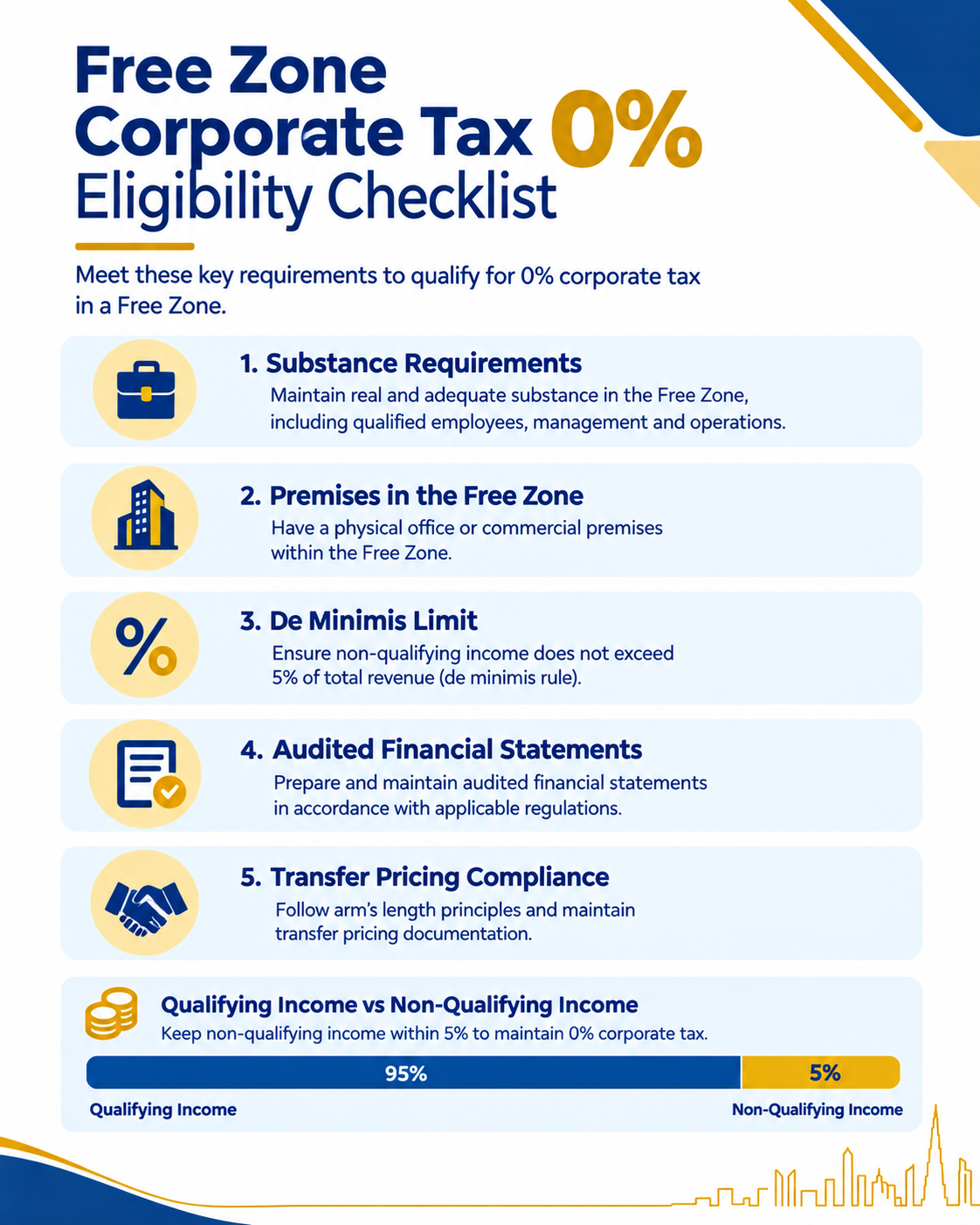
Here’s the eligibility test laid out as an actual checklist rather than a wall of explanation. Go through each item and be honest about whether you could produce evidence for it today, not whether it feels generally true of your business.
- The entity maintains adequate substance in the UAE relative to the scale of its activities
- Core management and strategic decisions are genuinely made in the UAE, not merely documented as if they were
- The entity earns income that falls within the categories classified as qualifying income
- Non-qualifying revenue stays within the de minimis limit set by the applicable Cabinet Decision
- Audited financial statements are prepared for the relevant tax period
- Transfer pricing rules are followed for any related party or connected person transactions
- The entity has not elected to be subject to the standard Corporate Tax regime instead
A single item on this list, unmet, is enough to strip 0% status for the period. That’s a deliberately unforgiving structure, and it’s why a checklist run quarterly rather than annually tends to catch problems while they’re still fixable.
Free Zone Economic Substance Requirements Checklist
Substance is the item on the list above that generates the most audit attention, so it’s worth breaking into its own working checklist.
Regulators are specifically looking for whether your substance is proportionate to the income you’re claiming as qualifying, not whether you have a substance policy document sitting in a drawer somewhere.
Personnel
- An adequate number of qualified, full-time employees are based in the UAE
- Staffing levels are proportionate to the scale and complexity of the business, not just a token hire
- Employment contracts, UAE residence visas, and payroll records are current and complete
- Any outsourced functions still leave the entity with genuine control, and the outsourced work is itself performed in the UAE
Premises
- The entity occupies a genuine office or operational space within a free zone
- A valid lease or licence to occupy is on file, not just a registered address
- The physical footprint is consistent with the declared scale of operations
- Utility bills and access records would support the claimed premises if checked
Core income-generating activities (CIGA)
- The activities that actually produce your income, sourcing and logistics for a trading business, service delivery for a services business, investment decisions for a holding structure, are performed in the UAE
- You’ve mapped, activity by activity, where each core function happens and by whom
- That mapping is current for the tax period you’re filing for, not a snapshot from setup
If any of these boxes would take you more than a few minutes to find evidence for, that’s a signal worth acting on before a filing deadline forces the issue.
Qualifying Income and the De Minimis Requirement: A Worked Example
The de minimis rule is where a lot of the confusion around “how much mainland business can I do” actually lives, and it’s easier to understand with real numbers than with the legal description alone.
The rule limits how much non-qualifying revenue a Qualifying Free Zone Person can earn before it jeopardises its status entirely. Say a free zone trading company earns AED 9,000,000 in total revenue for the period.
Of that, AED 8,500,000 comes from goods sold to customers outside the UAE and to other free zone entities, which falls within qualifying income categories. The remaining AED 500,000 comes from direct sales to mainland UAE customers, which is generally non-qualifying revenue.
Whether that AED 500,000 is a problem depends on the applicable de minimis threshold, which is calculated as the lower of a fixed AED amount or a percentage of total revenue set by the relevant Cabinet Decision.
If the company’s non-qualifying revenue stays under that limit, the qualifying income keeps its 0% treatment and only the non-qualifying portion is taxed at the standard rate.
If non-qualifying revenue exceeds the limit, the consequence isn’t just taxing that excess portion differently, it can disqualify the entity from Qualifying Free Zone Person status altogether for that period and potentially subsequent ones, meaning the entire AED 8,500,000 in otherwise-qualifying income loses its 0% treatment too.
This is why tracking the qualifying-versus-non-qualifying split needs to happen continuously through the year, not as a year-end exercise. A free zone company that picks up an unusually large mainland contract mid-year can tip its own ratio without anyone noticing until the numbers are compiled for filing, at which point the damage is already done for that period.
Free Zone Corporate Tax Registration Checklist for New Entities
If you’re setting up a new free zone entity, the compliance clock starts earlier than most founders expect, and getting the sequence right in year one avoids a scramble later.
- Confirm your free zone’s specific incorporation requirements are complete (licence issuance, lease agreement, initial approvals)
- Register for Corporate Tax with the Federal Tax Authority through the EmaraTax portal and obtain your corporate tax registration number
- Determine your tax period based on your financial year end, since every deadline that follows is calculated from that date
- Set up accounting records and a chart of accounts aligned with IFRS from day one, rather than retrofitting informal bookkeeping later
- Begin documenting substance evidence immediately: employment contracts as staff are hired, the lease agreement, and dated board minutes from your very first governance decisions
- Map your anticipated income sources against qualifying and non-qualifying categories before you start trading, so you know your de minimis exposure from the outset
- Schedule your first audit well ahead of your filing deadline, since Qualifying Free Zone Persons need audited financial statements
Businesses that treat registration as a one-time administrative task, rather than the start of an ongoing evidence-building habit, tend to be the ones scrambling to reconstruct board minutes and payroll records eighteen months later when the first real audit request lands.
Free Zone Corporate Tax Filing and Documentation Checklist
Once you’re operating, the filing and documentation obligations run on a predictable rhythm, but each element needs to be genuinely in place, not assumed. Since deadlines are calculated from your own tax period end rather than a single fixed date, it’s worth checking your specific dates against a current Corporate Tax return deadlines reference rather than assuming a generic timeline applies to your entity.
- Audited financial statements are finalised for the relevant tax period
- The Corporate Tax return is filed within nine months of the tax period ending
- Any tax due, on non-qualifying income or if qualifying status wasn’t maintained, is paid by that same deadline
- All supporting records are retained for at least seven years following the end of the relevant tax period
A documentation table is worth keeping close at hand, since these are the categories an auditor or the FTA will actually ask for:
| Documentation Category | What to Keep on File |
| Corporate governance | Trade licence, constitutional documents, shareholder register, dated board minutes |
| Financial records | General ledgers, trial balances, audited financial statements |
| Substance evidence | Employment contracts, visas, payroll records, lease agreements, utility and access records |
| Income mapping | Revenue analysis by counterparty and by qualifying or non-qualifying category |
| Transfer pricing | Intercompany agreements, benchmarking evidence, disclosure forms |
| Transaction evidence | Invoices, contracts, bank statements reconciled to the accounting records |
The through-line across all of these is that they need to be contemporaneous. A generic, undated board minute template, or a lease agreement that expired eighteen months ago, carries very little weight if your 0% claim is ever tested.
Free Zone Transfer Pricing Documentation Checklist
Transfer pricing deserves its own checklist because it’s easy to treat as a back-office formality when it actually has direct bearing on how much of your income legitimately counts as qualifying.
This applies as much to transactions with related parties as it does to connected persons under UAE Corporate Tax, a category that carries its own specific deductibility and disclosure conditions worth understanding separately from standard related party rules.
- Every related party and connected person transaction is identified and mapped, including intra-group services, financing, royalties, and goods
- An appropriate transfer pricing method has been selected and documented, with a functional analysis of each party’s roles, assets, and risks
- Pricing is supported by benchmarking evidence where thresholds require it
- Intercompany agreements actually reflect how the parties behave in practice, not a template signed once and forgotten
- Master file and local file obligations have been checked against your revenue and group structure to confirm whether they apply
- The transfer pricing disclosure form is prepared alongside the tax return where required
A common and expensive mistake here is charging a management or service fee between related entities with no evidence the service was actually performed, or booking profit in the free zone entity that’s disproportionate to the substance it actually holds.
Both are exactly the kind of mismatch that draws audit attention, because they suggest income is being shifted into the qualifying entity rather than genuinely earned there.
Non-Qualifying Activities and Common Free Zone Corporate Tax Mistakes
A few patterns show up repeatedly in free zone compliance reviews, and most of them are fixable if caught early.
Income from a mainland or foreign permanent establishment, and income from immovable property in a free zone that isn’t commercial property, generally falls outside qualifying income regardless of how the contract is labelled.
Businesses sometimes assume that because the invoicing entity is the free zone company, the income automatically qualifies. It doesn’t; what matters is where the activity generating that income actually happens and what kind of income it is.
Mismatched substance is another recurring issue: a free zone company reporting substantial qualifying income while its actual UAE headcount and premises look thin relative to that scale.
Auditors specifically look for this gap, because a business generating significant revenue through one or two administrative staff and a small serviced office is a textbook audit trigger.
If you discover mid-year that you’ve breached a condition, whether that’s a de minimis overage, a lapsed lease, or a substance shortfall, the right move is to address it immediately rather than hope it goes unnoticed at filing time.
Depending on the specifics, that might mean adjusting your income mix for the remainder of the period, increasing UAE-based substance before the period closes, or, where the breach can’t realistically be corrected in time, preparing to file that period under the standard tax treatment rather than making an unsupported 0% claim.
An unsupported claim that gets caught on audit costs considerably more, in reassessment and penalties, than proactively filing correctly for a period where qualifying status genuinely wasn’t maintained.
Free Zone Corporate Tax Compliance UAE: Interaction With Small Business Relief and VAT
This is a section that gets skipped surprisingly often, and it causes real confusion for free zone SME owners who’ve heard about Small Business Relief elsewhere.
Small Business Relief lets an eligible resident taxable person with revenue of AED 3,000,000 or less elect to be treated as having no taxable income for a period. It sounds like exactly the kind of relief a small free zone company would want to stack on top of its 0% ambitions. It isn’t available to you if you’re a Qualifying Free Zone Person.
The two regimes are mutually exclusive by design, because Small Business Relief is aimed at genuinely small businesses working through the standard tax regime, not at entities already accessing the free zone 0% framework.
If your free zone company doesn’t currently qualify as a Qualifying Free Zone Person for a given period, Small Business Relief may become relevant for that period instead, but the two aren’t something you get to choose between while holding qualifying status.
VAT sits in an entirely separate lane again. Corporate Tax’s AED 3,000,000 Small Business Relief threshold and the qualifying income tests covered throughout this checklist have no bearing on VAT registration, which becomes mandatory once taxable supplies and imports exceed AED 375,000 in a rolling 12-month period, a far lower bar.
A free zone company can be a well-documented Qualifying Free Zone Person with a clean 0% position and still be sitting well inside mandatory VAT registration territory, with its own filing calendar running independently.
Treating Corporate Tax compliance and VAT compliance as one combined task, rather than two separate obligations that happen to share some of the same underlying records, is where free zone businesses most often let one slip while focused on the other.
Corporate Tax for Free Zone Companies by Sector: What Changes for Trading, Services and E-Commerce
The core rules apply uniformly, but how they actually bite depends heavily on what kind of business you’re running.
A trading or logistics free zone company typically has the clearest de minimis exposure, since it’s the sector most likely to sell directly to mainland customers alongside international and free zone sales. These businesses benefit most from splitting revenue by counterparty type in their accounting system from day one, rather than reconstructing that split at year end.
A services or consultancy free zone company tends to face closer scrutiny on substance rather than de minimis, since services are easier to deliver with minimal genuine UAE presence. A consultancy invoicing significant fees through a free zone entity with one part-time UAE-based employee is a substance mismatch waiting to be flagged, regardless of how qualifying the income itself looks on paper.
An e-commerce free zone seller often has a more complex qualifying income question than either of the above, since online sales can span international customers, UAE mainland customers, and other free zone businesses within a single order flow.
These businesses benefit from building counterparty and delivery-location classification directly into their order management or accounting system, since manually reconstructing that split across potentially thousands of transactions at year end is close to unworkable.
None of this changes the underlying checklist. It changes which items on it deserve the closest attention for your specific business.
Free Zone Corporate Tax Penalties UAE: What Non-Compliance Actually Costs
The cost of getting this wrong extends well beyond simply losing the 0% rate for one period.
Failure to register for Corporate Tax within the required timeframe carries a fixed administrative penalty and tends to trigger closer FTA scrutiny of the entity generally.
Late filing of the tax return escalates the longer it’s outstanding, and late or short payment of tax due adds its own penalty on the outstanding amount, accruing until it’s settled.
Failure to keep the required records carries a separate administrative penalty, and it also weakens your ability to defend a 0% claim if one is ever questioned, since the absence of records is itself treated as a compliance failure regardless of what actually happened.
The most expensive scenario is an unsupported 0% claim that doesn’t survive review. That typically results in reassessment at the standard rate, plus penalties, and depending on the nature of the failure, it can affect not just the period in question but subsequent periods as well.
This is the core reason a working checklist, run consistently rather than reconstructed retroactively, is worth the ongoing effort: the cost of prevention is a fraction of the cost of correction after the fact.
FAQs on Qualifying Free Zone Person Status and Free Zone 0% Corporate Tax Conditions
What is a Qualifying Free Zone Person?
A Free Zone Person that meets the substance, income, and compliance conditions required to access the 0% Corporate Tax rate on its qualifying income. Holding a free zone licence alone doesn’t confer this status; it has to be actively met and evidenced.
What are the free zone 0% corporate tax conditions in brief?
Adequate UAE substance, income falling within qualifying categories, non-qualifying revenue staying under the de minimis limit, audited financial statements, and compliance with transfer pricing rules.
Can a free zone company elect Small Business Relief?
Not while holding Qualifying Free Zone Person status. The two regimes are mutually exclusive; Small Business Relief is only relevant for a period in which the entity isn’t operating as a Qualifying Free Zone Person.
What happens if non-qualifying revenue exceeds the de minimis limit?
It can strip Qualifying Free Zone Person status for that period, and potentially subsequent periods, meaning all income, not just the non-qualifying portion, loses access to the 0% rate.
Do DIFC or ADGM companies follow different rules?
The federal Corporate Tax rules apply the same qualifying conditions to DIFC and ADGM entities as any other free zone. What differs is the additional registry and reporting obligations each authority imposes alongside the federal rules, not the underlying tax conditions themselves.
How often should substance and eligibility be reviewed?
At least quarterly. These conditions are tested on an ongoing basis, not just at year end, and a quarterly review gives you enough time to correct course before a filing deadline locks in the consequences of a missed condition.
Use a Practical Checklist to Prepare for Free Zone Tax Compliance With Al Burhan Accounting & Taxation
Working through every checklist in this guide gives you a genuinely clear picture of where your free zone company stands, but applying it correctly to your specific structure, income mix, and sector is where professional guidance earns its cost.
Al Burhan Accounting and Taxation can review your substance evidence, map your qualifying and non-qualifying income, and keep your accounting and bookkeeping and VAT compliance aligned with your Corporate Tax position rather than managed as separate, disconnected tasks. Book a consultation to get a clear, practical read on your free zone compliance position before your next filing deadline.