Accounting Firm in Dubai — Tax, VAT & Audit Services UAE | Al Burhan

In-House vs. Outsourced CFO in Dubai: Cost Comparison & When to Hire

Most founders and business owners in Dubai frame this as a yes or no question: do we hire a CFO, or do we not. That’s the wrong question, and it’s the reason so many businesses either overpay for financial leadership they don’t yet need, or underinvest in it for years past the point where it would have paid for itself. The real decision isn’t full-time versus nothing.
It’s full-time versus fractional versus outsourced, and each of those solves a genuinely different problem at a genuinely different price point.
This matters more in Dubai specifically than it might elsewhere, because the cost structure behind a full-time executive hire here carries components that don’t show up on a simple salary comparison: visa sponsorship, end-of-service gratuity, benefits, and the very real cost of a bad hire in a role this senior. Understanding the true cost of each option, not just the headline number, is what actually lets you make the right call for where your business is right now.
What Does a CFO Actually Do, and Why Timing the Hire Matters
Before comparing costs, it’s worth being honest about what a CFO role actually covers, because a lot of businesses reach for the title when what they actually need is something narrower and cheaper.
A CFO owns financial strategy: capital allocation, fundraising, cash flow forecasting at a strategic level, board and investor relationships, and the judgment calls that determine whether an expansion, an acquisition, or a raise makes sense.
That’s a different job from bookkeeping, VAT filing, or even monthly management reporting, all of which matter enormously but don’t require CFO-level judgment to execute well.
Getting this distinction right upfront avoids the most common and expensive mistake in this whole decision: paying CFO rates for work a bookkeeper or financial controller could do, or expecting a controller to make CFO-level strategic calls they were never hired or paid to make.
Cost of Hiring a CFO in Dubai: The True In-House Number
The headline salary figure for a full-time CFO in Dubai is only part of the actual cost, and it’s the smaller part more often than people expect.
Base salaries for an experienced full-time CFO in Dubai typically range from around AED 400,000 to AED 900,000 or more annually, depending on company size, sector, and the seniority of the person you’re bringing in.
According to salary benchmarking data published by Robert Half, CFO compensation globally spans a wide percentile range even before accounting for regional cost-of-living and market differences, which is a useful reminder that “CFO salary” isn’t a single number so much as a range shaped heavily by scope and seniority.
Here’s where the real cost starts to diverge from that headline figure. In the UAE, a full-time employment relationship comes with mandatory end-of-service gratuity, calculated based on the employee’s length of service and final salary, accruing as a liability throughout their employment regardless of when you actually pay it out.
Official UAE guidance on end-of-service gratuity calculation sets out exactly how this is worked out, and it’s a cost that’s easy to forget about until the day an employee leaves and the payout comes due all at once.
Add to that health insurance, any housing or transport allowance offered, annual leave and paid holidays, recruitment fees if you use an executive search firm, which for a role this senior can run into tens of thousands of dirhams on its own, and the months of reduced productivity while a new hire ramps up.
A CFO with an all-in base salary of AED 500,000 can realistically cost the business AED 650,000 to AED 750,000 or more in the first year once all of this is factored in.
And if the hire doesn’t work out, which happens more often at this seniority level than most businesses like to admit, you’re absorbing a meaningful portion of that cost again while you restart the search.
What Is a Fractional CFO in the UAE?
A fractional CFO provides senior financial leadership on a part-time or scaled basis, typically engaged for a set number of days or hours per month rather than as a full-time employee.
The engagement can run as an ongoing retainer or be scoped around a specific project, a fundraise, a restructuring, preparation for an audit or investment round.
The UAE fractional CFO market genuinely splits into two distinct tiers, and understanding which one you’re actually looking at matters more than the headline monthly fee.
At the lower end, roughly AED 4,000 to AED 10,000 a month, providers are typically offering outsourced finance and controller-level work: bookkeeping oversight, VAT compliance, management accounts, basic reporting. That’s useful, valuable work, but it isn’t CFO-level strategic input.
At the higher end, roughly AED 15,000 to AED 40,000 or more a month, you’re paying for an experienced CFO who sits with founders and boards on capital structure, fundraising, M&A, and the decisions that actually shape where the business ends up, often drawing on business valuation and feasibility analysis to support those calls.
Comparing a AED 5,000 monthly retainer against a AED 25,000 one as if they’re the same service is a mistake that costs businesses real money in mismatched expectations.
Outsourced CFO vs Full-Time CFO: Side-by-Side Cost Comparison
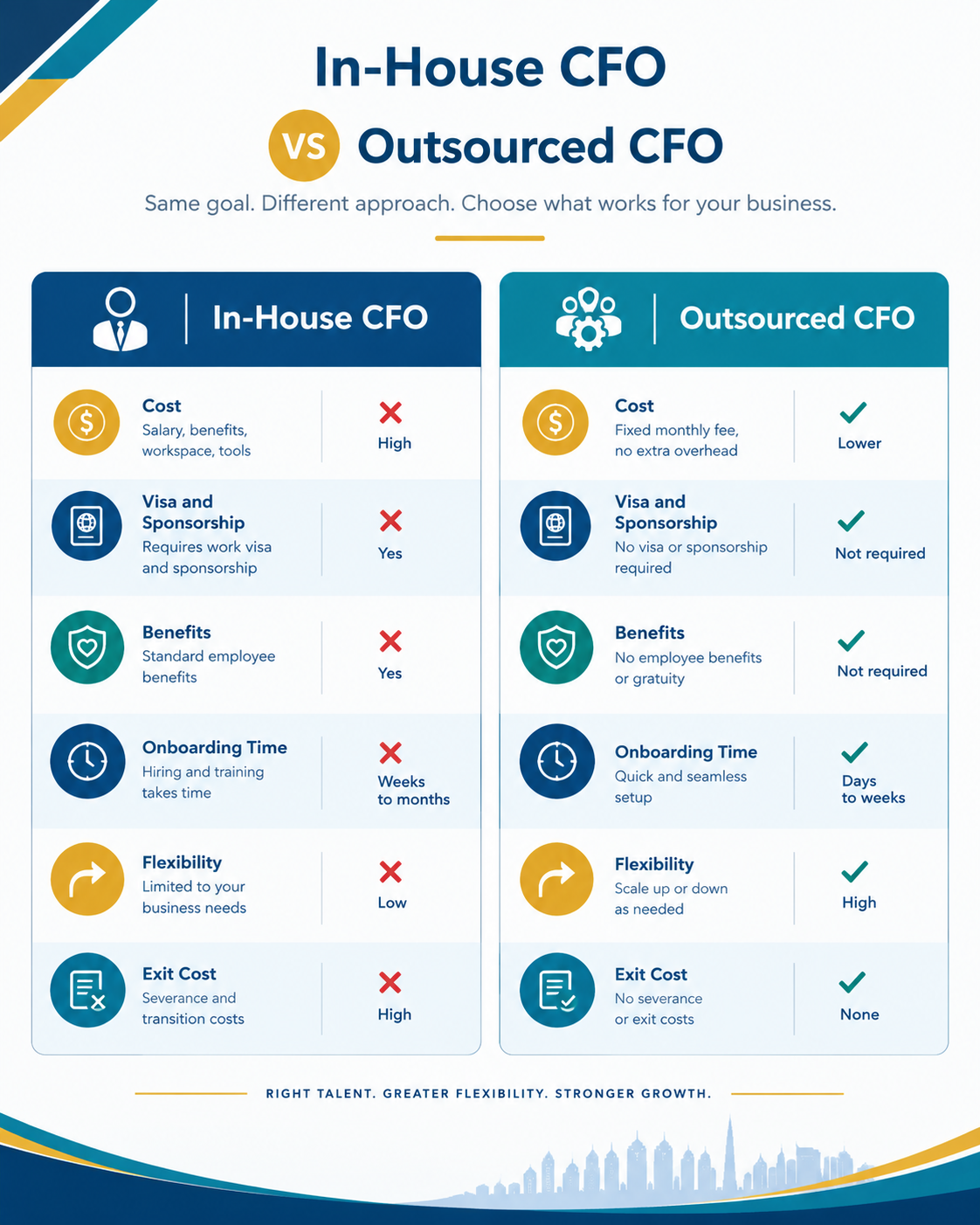
Laid out directly against each other, the practical differences are clearer than most narrative comparisons make them look.
| Factor | Full-Time In-House CFO | Fractional / Outsourced CFO |
| Base cost | AED 400,000 to 900,000+ annually | AED 4,000 to 40,000+ monthly, scaled to scope |
| Visa and sponsorship | Required, adds administrative overhead | Not applicable, company-to-company arrangement |
| End-of-service gratuity | Accrues throughout employment, paid on exit | None |
| Benefits (health, leave, allowances) | Standard employment cost | None, typically invoiced cleanly |
| Onboarding time | Weeks to months before full productivity | Senior-level output from day one in most cases |
| Flexibility | Fixed cost regardless of workload fluctuation | Scales up or down with actual need |
| Breadth of expertise | Limited to one person’s background | Often backed by a team with varied sector exposure |
| Cost if the arrangement doesn’t work | Severance exposure, restart of a lengthy search | Engagement ends cleanly, no severance liability |
| Depth of daily involvement | Present every day, deeply embedded | Present for scoped hours, not continuous |
The pattern that emerges is fairly clear: full-time in-house makes sense when you need continuous, deeply embedded daily involvement, and fractional makes sense when you need senior judgment without needing it in the room every single day.
In-House CFO Considerations: Visa, Free Zone vs Mainland, and Headcount
If you do decide a full-time hire is right, there’s a UAE-specific layer worth planning around before you start the search.
Free zone companies operate under visa quotas tied to their office size and licence category, and an executive-level visa still needs to fit within that quota, which occasionally requires upgrading your office package or licence tier specifically to accommodate a senior hire.
Mainland companies generally have more flexibility here but still carry their own sponsorship obligations and the same gratuity accrual regardless of free zone or mainland status.
This is worth checking before you commit to a search, not after you’ve found the right candidate, since discovering a visa quota constraint midway through a hiring process is a frustrating and entirely avoidable delay.
When Does Your Business Actually Need a Full-Time CFO?
A handful of concrete signals tend to indicate that fractional support has reached its limit and a full-time hire is genuinely justified.
Multi-entity group structures, where financial decisions need to be coordinated daily across several legal entities, usually outgrow fractional coverage quickly.
A daily executive decision load, where the CEO needs a financial partner in the room for decisions happening multiple times a week rather than a few times a month, points the same way.
And a board or investor cadence that expects constant, embedded presence rather than periodic engagement is another clear signal, particularly for a business that’s raised significant institutional capital and is expected to operate with a full executive bench.
None of these signals are about revenue size alone. A business can be doing very healthy revenue and still be well served by fractional support, if the complexity of the decisions being made doesn’t yet require daily embedded presence.
When a Fractional or Outsourced CFO Makes More Sense
For a lot of UAE businesses, fractional support isn’t a stepping stone to something better, it’s genuinely the right long-term fit.
Start-ups and early-stage businesses benefit enormously from senior financial judgment without carrying full-time executive overhead before revenue justifies it.
Steady-state SMEs, where financial complexity is real but not escalating quickly, often get everything they need from a scoped monthly retainer covering business planning and budgeting without ever needing to convert it to a full-time role.
And project-based needs, a fundraise, a restructuring, preparation for an audit or a due diligence process, are frequently better served by a defined-scope engagement than by hiring someone full-time for a need that has a clear end date. .
The Hybrid Path: Starting Fractional, Scaling to Full-Time
One approach that gets surprisingly little attention is treating fractional and full-time as stages of the same journey rather than a permanent either-or choice.
A business might start with a fractional CFO at a few days a month while it’s finding its footing, then increase those days as complexity grows, and eventually convert to a full-time hire once the workload has grown to genuinely justify continuous daily presence.
This lets a business scale its financial leadership cost in step with its actual need, rather than either overcommitting early or waiting too long to bring in senior expertise at all.
The trigger point for that conversion tends to be less about a specific revenue number and more about whether the fractional CFO’s actual time commitment has quietly grown to the point where near-daily presence would genuinely change outcomes.
When a fractional engagement that started at four days a month has effectively become fifteen, that’s usually the signal that the conversation about full-time has already been overdue for a while.
How a CFO Fits Into Your UAE Tax and Compliance Picture
Financial leadership and tax compliance aren’t separate conversations, even though businesses sometimes treat them that way.
A CFO, whether full-time or fractional, is typically the person responsible for ensuring Corporate Tax positions are correctly managed, VAT obligations are met on schedule, and the financial reporting that feeds both is accurate and current.
For a free zone entity, that includes staying on top of afree zone corporate tax compliance checklist to protect its 0% eligibility, and for a smaller business it may mean weighing whether UAE Small Business Relief genuinely applies rather than assuming it does.
A CFO overseeing a group with intercompany transactions also needs to track how connected persons rules under UAE Corporate Tax affect related-party dealings.
and typically works alongside corporate governance advisory to keep board-level oversight aligned with these obligations. If your business is navigating any of this, that oversight naturally sits under the same financial leadership function you’re deciding how to resource here. .
How to Choose an Outsourced or Fractional CFO in the UAE
Not every provider advertising CFO services is offering the same thing, and vetting properly before committing saves a lot of mismatched expectations later.
Worth checking directly: does the provider hold a recognized accounting credential and can they demonstrate genuine experience at the level you actually need, strategic CFO work rather than controller-level services marketed under a CFO label.
Are the hours or scope of the engagement clearly defined upfront, rather than a vague “as needed” retainer that leaves both sides guessing.
Do they have relevant sector experience, since financial priorities differ meaningfully between a trading business, a services company, and a venture-backed start-up.
And can they provide references from businesses of a similar size and stage to yours, not just a generic client list.
A provider that can’t clearly articulate what hours buy you, and what they don’t, is a sign to keep looking rather than a detail to overlook.
FAQs on CFO Costs and Hiring Decisions in the UAE
How much does a CFO cost in Dubai?
A full-time CFO typically costs AED 400,000 to 900,000 or more annually in base salary alone, rising meaningfully once benefits, visa costs, and gratuity accrual are factored in.
Fractional CFOs range from roughly AED 4,000 to 10,000 a month for outsourced finance-level work, up to AED 15,000 to 40,000 or more monthly for experienced, strategic CFO-level engagement.
Is a fractional CFO cheaper than a full-time CFO?
Generally yes, both in direct fees and in avoided costs like visa sponsorship, gratuity accrual, and benefits, though the comparison depends heavily on how much time and seniority your business actually needs.
What’s the difference between a fractional CFO and a financial controller?
A financial controller manages the close process, internal controls, and day-to-day financial operations. A fractional CFO operates at a more strategic level, involved in capital decisions, fundraising, and board-level financial direction, even while working part-time.
Can a fractional CFO become a full-time hire later?
Yes, and this is a common and sensible path. Many businesses start with fractional support and transition to a full-time hire once the workload and complexity have grown enough to justify continuous daily presence, sometimes with the same person making that transition directly.
Get the Right Financial Leadership for Your Business With Al Burhan Accounting & Taxation
Whether your business needs a fully embedded CFO or senior financial judgment on a scoped, flexible basis, getting that decision right starts with an honest look at your current complexity and what’s actually driving your financial decisions today.
Al Burhan Accounting and Taxation’ soutsourced CFO services in Dubai give you access to senior financial expertise without the overhead of a full-time executive hire, scaled to exactly what your business needs right now. Book a consultation to talk through which path makes sense for your stage.