Accounting Firm in Dubai — Tax, VAT & Audit Services UAE | Al Burhan

Corporate Restructuring Under UAE Tax Law: Tax-Free Business Restructuring Relief Explained
Introduction
A merger, a spin-off, or simply moving a division into its own entity sounds like a purely legal and operational exercise, until the Corporate Tax bill shows up.
Transferring a business, or even part of one, is generally treated as happening at market value, which means the difference between what the business is actually worth and what it sits at on the books becomes a taxable gain the moment the transfer completes.
For a genuine commercial reorganisation, that outcome feels backwards. You’re not selling the business or extracting cash from it, you’re restructuring how it’s held, and yet the tax system’s default treatment can still generate a real liability.
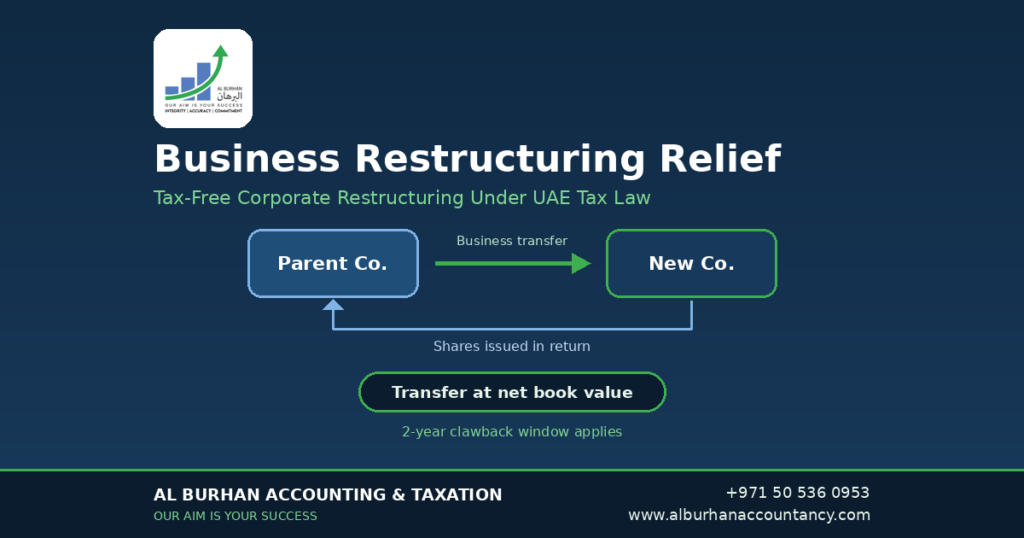
Business Restructuring Relief exists precisely to fix that mismatch. Under Article 27 of the UAE Corporate Tax Law, a qualifying restructuring transaction can happen on a tax-neutral basis, with no immediate gain or loss recognized purely because of the transfer.
The Federal Tax Authority’s own Corporate Tax Guide on Business Restructuring Relief sets out the detailed conditions and worked scenarios behind this relief. It isn’t automatic, though, and it isn’t a permanent tax exemption either.
It has to be actively elected, every condition has to be satisfied, and the relief carries a clawback mechanism that can reverse the entire benefit if the wrong thing happens within two years.
This guide walks through exactly how the relief works, what qualifies, and where businesses most commonly get it wrong.
What Is Business Restructuring Relief Under UAE Corporate Tax?
Without this relief, transferring a business or its assets to another taxable person is treated as happening at market value.
If the business is worth more than its net book value, which is common for an established operation with goodwill, customer relationships, or appreciated assets, that difference becomes a taxable gain in the hands of the transferor, payable even though no cash actually changed hands from a sale.
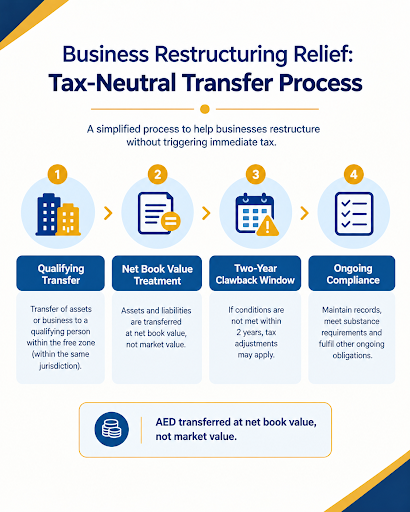
Business Restructuring Relief changes this treatment for qualifying transactions. When the relief is properly elected and every condition is met, the assets and liabilities being transferred are treated as moving at their net book value instead of market value, meaning no taxable gain or loss arises purely from the transfer itself.
Shares or other ownership interests received as consideration are treated as having a value not exceeding that net book value.
Here’s what this looks like with real numbers. Say a UAE company is restructuring by transferring an independent software division to a new subsidiary in exchange for shares.
The division’s net book value, its assets minus liabilities as carried in the accounting records, comes to AED 6,000,000. An independent valuation puts the division’s actual market value at AED 14,000,000, reflecting its customer base, recurring revenue, and accumulated goodwill.
Without Business Restructuring Relief, that AED 8,000,000 difference would be treated as a taxable gain for the transferor, generating a Corporate Tax liability of AED 720,000 at the standard 9% rate.
With the relief properly elected and all conditions satisfied, the transfer instead happens at the AED 6,000,000 net book value, and no taxable gain arises at the point of transfer.
It’s important to understand that this relief generally defers the tax consequence rather than eliminating it permanently.
The transferee inherits the transferred net book value as its own tax basis, so if it later disposes of those assets, the gain that was never recognized at the point of restructuring can surface at that later disposal, calculated against the original net book value rather than a stepped-up basis.
Transfer of a Qualifying Business: What Actually Counts
The relief applies to two categories of transaction. The first is a transfer of an entire business, or an independent part of a business, from one taxable person to another.
The second is where one or more taxable persons transfer their entire business to another taxable person and the transferor subsequently ceases to exist, relevant to qualifying legal mergers.
The distinction between a genuine business transfer and a mere asset transfer matters enormously here, and it’s where a lot of restructurings fail to qualify without anyone realizing it upfront.
An independent part of a business needs to be capable of operating on its own, with its own assets, liabilities, functions, and operational components. Transferring an isolated asset, a piece of equipment, a customer list, a single property, doesn’t qualify merely because that asset happened to be used within the business.
The test is whether what’s being transferred could function as a standalone business in the hands of the transferee.
Take the software division example from earlier. If the entire division moves, including its employees, customer contracts, operating systems, and related liabilities, and it can genuinely function independently after the transfer, that’s a strong candidate for qualifying treatment.
If instead only the software licence itself moves, while the employees, contracts, and day-to-day operating functions stay behind with the original company, that’s an asset transfer dressed up as a business transfer, and it’s unlikely to qualify.
Examples that typically fall within scope, subject to meeting every other condition, include converting a sole proprietorship into an incorporated company, an unincorporated partnership applying to become a taxable person in its own right, a legal demerger of an independent business part, certain hive-down transactions into a subsidiary, and a legal merger where the transferor’s entire business moves to the transferee under universal title.
What typically falls outside scope includes assets or liabilities transferred because of a liquidation, a subsidiary merging into its parent where the subsidiary’s shares are simply cancelled by law, and a company transferring a business to a wholly owned subsidiary or parent without issuing any shares or ownership interest in return.
Conditions for Business Restructuring Relief UAE
For the relief to apply, every one of the following conditions needs to be satisfied, and the transferor needs to actively elect for it:
- The transfer is undertaken in accordance with, and meets all conditions imposed by, the applicable legislation of the UAE, including company law and any sector-specific or free zone regulations
- The transferor and transferee are Resident Persons, or Non-Resident Persons with a Permanent Establishment in the UAE
- Neither the transferor nor the transferee is an Exempt Person or a Qualifying Free Zone Person in the tax period the transaction takes place
- The financial year of the transferor and transferee ends on the same date, though this doesn’t necessarily require them to share the same tax period
- The transferor and transferee prepare their financial statements using the same accounting standards
- The transfer is undertaken for valid commercial or other non-fiscal reasons that reflect economic reality
Missing even one of these conditions means the relief simply doesn’t apply, and the transfer reverts to being taxed at market value as though the relief had never been considered.
This is why restructuring transactions need tax input well before the legal documents are signed, not as an afterthought once the deal structure is already locked in.
Transfer of Business in Exchange for Shares: How the Relief Actually Works
The consideration for a qualifying business transfer generally needs to consist of shares or other ownership interests in the transferee.
This is a meaningful structural requirement, not a formality: a transfer done purely for cash, with no shares issued in return, doesn’t fit the relief’s intended shape, since the relief is built around continuity of ownership interest rather than an outright sale.
Depending on the structure, those shares might be issued to the transferor directly, or in certain configurations to another eligible person within the required ownership relationship.
Some limited non-share consideration may be permitted alongside the share issuance under specific conditions, but the mechanics here are technical enough that they deserve review before the restructuring agreement is signed, not after, since getting the consideration structure wrong can unwind the entire relief claim retroactively.
Valid Commercial or Economic Reasons: Why This Condition Gets Challenged Most
Of all the conditions, this is the one most likely to draw scrutiny, because it’s inherently a judgment call rather than a bright-line test.
The transaction needs to be undertaken for genuine commercial or non-fiscal reasons that reflect economic reality, not primarily to secure a tax advantage.
Genuine commercial reasons that tend to hold up include separating distinct business divisions that have grown apart operationally, improving efficiency by consolidating overlapping functions, preparing a specific division for external investment or a future sale, converting a business into a more suitable legal form as it scales, simplifying an increasingly complex group structure, and supporting succession or ownership transition plans.
What tends not to hold up is a restructuring whose primary or sole discernible purpose is generating a tax benefit, with no operational, ownership, or strategic rationale behind it.
The practical takeaway is that documentation matters as much as the underlying intent.
A restructuring undertaken for genuinely sound commercial reasons can still run into trouble on review if nobody wrote down what those reasons were at the time, board minutes, a restructuring memo, correspondence with advisors discussing the operational rationale.
Reconstructing the commercial justification after the fact, once a tax authority is asking questions, is far less convincing than having it documented contemporaneously.
Business Restructuring Relief vs Qualifying Group Relief: Key Differences
These two reliefs get confused constantly, partly because they can overlap on the same transaction, and partly because both result in a tax-neutral, net-book-value transfer. Laid out side by side, the practical differences are clearer.
| Factor | Business Restructuring Relief | Qualifying Group Relief |
|---|---|---|
| Legal basis | Article 27 | Article 26 |
| What’s being transferred | An entire business or independent business part | Individual assets or liabilities, not necessarily a whole business |
| Ownership requirement | No minimum common ownership threshold between transferor and transferee | Requires at least 75% common ownership between transferor and transferee |
| Consideration required | Generally shares or ownership interests | No share issuance required |
| Election scope | Elected separately for each qualifying transaction | Once elected, generally applies to all of a transferor’s subsequent qualifying transfers |
| Clawback trigger | Two years from the transfer date | Two years from the transfer date |
| Can overlap with the other relief | Yes, a transaction can potentially qualify for both, subject to satisfying both sets of conditions | Yes, same as noted |
The core distinction worth remembering is scope and ownership. Qualifying Group Relief is built for moving assets within a tightly held group, at least 75% common ownership, without needing a whole business or shares changing hands.
Business Restructuring Relief is built for actual business transfers, mergers, demergers, and reorganisations, often between parties without that tight ownership link, but it specifically requires share consideration and a genuine business, not just an asset, moving hands.
Deloitte’s analysis of the relief notes that a single transaction can potentially qualify for both reliefs at once, subject to satisfying the full conditions and clawback provisions of each.
Business Restructuring Relief and Small Business Relief: Can You Claim Both?
No, and this is a genuinely underexplained interaction that catches smaller businesses off guard during a restructuring.
If a Resident Person has elected Small Business Relief for a tax period, treating itself as having no taxable income under the AED 3,000,000 revenue threshold, it is not entitled to also elect Business Restructuring Relief for that same period.
This matters in practice for a small business that’s grown to the point of restructuring, perhaps splitting into two entities ahead of bringing in an investor, while its revenue still sits under the Small Business Relief threshold.
If that business has been claiming Small Business Relief, it needs to actively decide whether to continue claiming it or step out of that election in order to access Business Restructuring Relief for the transaction it’s planning.
These aren’t reliefs that can be layered together in the same period, and the decision of which one serves the business better depends heavily on the specific numbers involved in both the ongoing operation and the restructuring transaction itself.
Corporate Tax Treatment of Mergers and Spin-Offs in the UAE
Mergers and demergers sit squarely within the relief’s intended scope, provided the underlying structure meets every condition already covered.
A legal merger, where one company’s entire business transfers to another under universal title and the transferor ceases to exist, fits the second category of qualifying transaction described earlier.
A demerger, where an independent part of a business splits off into a separate entity, fits the first category, provided that demerged part can genuinely operate independently.
Hive-down transactions, where a business or division moves into a newly created subsidiary ahead of a planned sale or investment, are another common structure that can qualify, and this is frequently seen when a company is preparing a specific division for external investors without disturbing the rest of the group’s operations.
The legal form and actual mechanics of each transaction need careful review though, since a transaction that looks like a merger commercially might not meet the specific legal and tax conditions required, particularly around whether shares are genuinely issued as consideration and whether the transferor’s status changes as required.
Business Restructuring Relief Clawback: The Two-Year Rule Explained
The clawback provision is the single biggest risk in this entire relief, and it deserves to be understood in concrete terms rather than as an abstract warning tucked into the conditions list.
The relief can be clawed back if, within two years of the restructuring date, shares or ownership interests received as part of the transaction are subsequently transferred outside the relevant ownership group, or the transferee disposes of the transferred business or independent business part.
If either of these happens within that window, the original transfer is treated as having occurred at market value on the original restructuring date, not the date of the later disposal, and the gain that was never recognized at the time of restructuring becomes taxable retrospectively.
Walk through a concrete timeline. A company transfers its logistics division, with a net book value of AED 5,000,000 and a market value of AED 11,000,000, to a new subsidiary on 1 March 2025, electing Business Restructuring Relief and paying no tax on the AED 6,000,000 difference at that time. On 15 January 2027, less than two years later, the new subsidiary’s shares are sold to an unrelated third party.
That sale falls within the two-year clawback window. The original 2025 transfer is now retroactively treated as having occurred at the AED 11,000,000 market value, and the AED 6,000,000 gain that went unrecognized in 2025 becomes taxable in the 2027 tax period, generating a Corporate Tax liability of AED 540,000 at the standard 9% rate, three years after the original transfer took place and calculated against 2025’s numbers.
The clawback also has more granular mechanics worth knowing. It applies to a transfer “in whole or in part,” meaning even a single share out of a larger block that was issued as part of the original relief can trigger the clawback if it’s transferred within the two-year window.
Where it’s not practically possible to identify exactly which shares are being transferred out of a larger holding, a first-in-first-out basis is applied, treating the earliest-acquired shares as the ones being disposed of first.
And notably, simply becoming an Exempt Person or a Qualifying Free Zone Person in a later tax period does not, by itself, trigger a clawback of relief claimed in an earlier period, that specific change in status isn’t treated as the kind of disposal event the clawback rule targets.
Business Restructuring Relief for Free Zone Companies
A free zone entity restructuring its operations needs to pay particularly close attention to the QFZP exclusion condition, since it can quietly disqualify an otherwise well-structured transaction.
Take a free zone trading company that has achieved Qualifying Free Zone Person status, benefiting from the 0% Corporate Tax rate on its qualifying income.
If this company wants to transfer part of its business to a new subsidiary in exchange for shares, and it’s a QFZP at the time the transaction takes place, it cannot claim Business Restructuring Relief for that transfer, regardless of how sound the commercial rationale is or how cleanly the other conditions are met.
The exclusion applies specifically to QFZP status held at the time of the transaction, not free zone location generally, so a Free Zone Person that hasn’t achieved QFZP status, or has voluntarily elected out of it, isn’t automatically excluded on this basis alone.
This creates a genuine planning consideration for free zone groups. A business restructuring involving a QFZP entity might need to be sequenced carefully, potentially timing the transaction around a period where QFZP status isn’t in effect, or accepting that the transfer will be taxed at market value if QFZP status can’t practically be set aside.
This is exactly the kind of interaction that benefits from reviewing a business’s Qualifying Free Zone Person status alongside any restructuring plans, rather than treating the two as unrelated questions.
Documentation and Compliance Requirements for Claiming the Relief
Unlike Qualifying Group Relief, which once elected generally applies to all of a transferor’s subsequent qualifying transfers, Business Restructuring Relief has to be elected separately for each individual restructuring transaction that meets the conditions.
Electing it for one transaction doesn’t carry forward automatically to a future, unrelated restructuring.
Both the transferor and transferee are required to maintain records of the agreement to transfer the assets or liabilities at the prescribed value, and to document the adjustments required as a result.
In practice, the documentation worth keeping includes board and shareholder resolutions authorizing the transaction, the business transfer agreement itself, legal merger or demerger documents, a clear written record of the commercial reasons behind the restructuring, valuation and net book value schedules, details of the specific assets and liabilities transferred, evidence supporting that an independent business (not just isolated assets) was transferred, share issuance and ownership records, and financial statements and tax computations from both parties showing consistent treatment.
Where the transferor and transferee are related parties, this documentation should also address how connected persons rules under UAE Corporate Tax apply to the transaction.
Corporate Tax records generally need to be retained for at least seven years following the end of the relevant tax period, and clawback monitoring records specifically need to be kept for at least that two-year window following the transaction, since that’s the period during which a disposal could unwind the relief entirely.
How to Apply for Business Restructuring Relief in the UAE
The election itself is made by the transferor in its Corporate Tax return for the relevant tax period, it isn’t something that can be informally noted in the accounting records or assumed by default.
Given that the election is transaction-specific, timing matters: the restructuring’s legal steps, an independent business valuation, and commercial rationale documentation should ideally be finalized before the transaction completes, so that the election in the subsequent tax return is supported by evidence that already existed at the time of the transfer, rather than assembled afterward.
Coordinating legal restructuring documentation with the tax election is where a lot of practical friction shows up.
Lawyers structuring the merger or demerger agreement and the corporate tax advisory team preparing the Corporate Tax position need to be working from the same facts, particularly around the exact value being used for the transfer, the shares being issued, and the commercial justification being recorded, since inconsistencies between the legal paperwork and the tax return are exactly the kind of thing that draws scrutiny on review.
FAQs on Business Restructuring Relief and Qualifying Business Transfers
Can a free zone company claim Business Restructuring Relief?
Only if it isn’t a Qualifying Free Zone Person at the time of the transaction. A Free Zone Person that hasn’t achieved or has stepped outside QFZP status can potentially qualify, subject to meeting every other condition, but an entity holding QFZP status at the time of transfer is excluded.
What happens if the clawback period is triggered?
The original transfer is treated as having occurred at market value on the original restructuring date, and the previously unrecognized gain becomes taxable in the tax period the clawback event happens, potentially years after the original transaction.
Is Business Restructuring Relief automatic or elected?
It’s elected. The transferor must actively claim it in the Corporate Tax return for the relevant period, and every condition needs to be satisfied for the election to be valid.
Can this relief apply to a partial business transfer?
Yes, provided what’s transferred qualifies as an independent part of a business, capable of operating on its own, rather than isolated assets that happened to be used within the broader business.
Structure Your Business Restructuring Correctly With Al Burhan Accounting & Taxation
Business Restructuring Relief can make a genuine reorganisation tax-neutral, but every condition needs to be satisfied and properly documented before the transaction completes, and the two-year clawback window means the planning doesn’t stop once the deal closes.
Al Burhan Accounting and Taxation, business restructuring consultants in Dubai, can review your plans, assess eligibility against the conditions covered here, and help coordinate the tax election with your legal documentation. Book a consultation before your next restructuring transaction to make sure it’s structured correctly from the outset.
More Insights