Accounting Firm in Dubai — Tax, VAT & Audit Services UAE | Al Burhan

UAE Excise Tax Return Filing: Deadlines, Requirements and Procedures
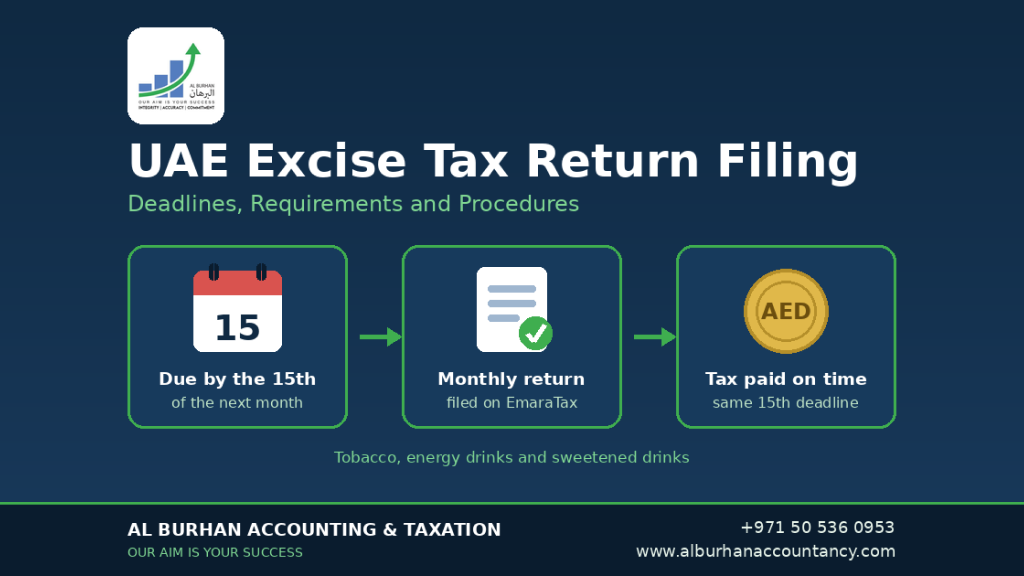
If your business imports, produces or stockpiles tobacco, energy drinks or sweetened drinks, UAE excise tax return filing is not an annual chore you can plan around.
It comes round every month, the deadline is short, and the rules for sweetened drinks changed at the start of 2026.
Many guides online still describe the old 50% model, so it is worth reading this one with the current rules in mind.
Below you will find who has to file, when, how to do it on EmaraTax, how the tax is worked out, and what a mistake costs.
What Is UAE Excise Tax Return Filing?
UAE excise tax return filing is the monthly declaration a registered business makes to the Federal Tax Authority (FTA).
The return reports the excise goods you imported, produced, stockpiled or released from a designated zone during the period, works out the excise tax due, and is submitted and paid through EmaraTax.
If you are registered, you file every period, including periods where there is little or nothing to pay.
Understanding Excise Tax in the UAE
Excise tax was introduced across the UAE in 2017. It is an indirect tax on goods considered harmful to health or the environment, which the law calls excise goods.
It is charged once, early in the supply chain, usually when goods are imported, produced or taken out of a designated zone. It then sits in the price that consumers pay.
It is separate from VAT. A drink can carry both: excise tax first, then 5% VAT on the price including the excise. Your VAT return and your excise return are different filings with different deadlines.
Which Goods Are Subject to UAE Excise Tax?
The excise goods in the UAE are tobacco and tobacco products, electronic smoking devices and the liquids used in them, energy drinks, and sweetened drinks.
Tobacco products, electronic smoking devices and their liquids, and energy drinks are taxed at 100% of the excise price. Sweetened drinks changed on 1 January 2026.
The old flat 50% rate, which also covered carbonated drinks as a category, was replaced by a tiered volumetric model based on the sugar in the drink:
| Sugar per 100 ml | Excise tax per litre |
| Less than 5g, or only artificial sweeteners | AED 0 |
| 5g or more, but less than 8g | AED 0.79 |
| 8g or more | AED 1.09 |
Energy drinks stay outside this model at the 100% rate. Drinks that contain only natural sugar, such as 100% juice with nothing added, fall outside the sweetened drinks category.
Rates and definitions are set by Cabinet decision, so check the FTA before relying on any table, including this one.
Who Is Required to File an Excise Tax Return?
Any business that imports, produces or stockpiles excise goods in the UAE, or releases them from a designated zone, must register for excise tax and then file returns. There is no turnover threshold.
A very small importer has the same filing obligation as a large manufacturer, which is quite different from Corporate Tax, where Small Business Relief extended to 2029 depends on a business staying under a revenue limit.
Registration comes before the activity, not after it. A retailer who only buys goods that have already borne excise tax from a registered supplier generally does not file excise returns, but the position depends on how the business operates, so confirm it before assuming.
UAE Excise Tax Return Filing Deadlines
The timetable is the part of excise that catches people out, because it is far tighter than the VAT or Corporate Tax calendar. The FTA sets out the rule on its excise tax page, and the FTA also posts a notice of the final deadline each month.
How Often Must Businesses File Excise Tax Returns?
Monthly. The standard excise tax period is one calendar month, unless the FTA assigns a different period to your business, so look at your EmaraTax account to see what applies to you. One return is due for each period, even when you had no excise goods activity to report.
What Is the Deadline for Submitting an Excise Tax Return?
The return and the payment are both due by the 15th day of the month following the end of the tax period. A return for October activity is due by 15 November. A return for the period ending 30 June is due by 15 July.
The 15th sometimes falls on a weekend or public holiday, so use the final deadline the FTA publishes for that month instead of assuming. Other taxes run on different timetables.
Corporate Tax, for example, is generally due nine months after the period ends, which you can check in our guide to Corporate Tax return deadlines.
What Happens If You Miss an Excise Tax Filing Deadline?
Filing late and paying late are two separate penalties, and you can trigger both. A late return carries a fixed administrative penalty. Tax that is not paid on time attracts a further charge for as long as it stays unpaid. The amounts are in the penalties section below.
The same penalty framework applies to VAT, and our summary of VAT penalties in the UAE is a useful comparison.
Requirements for UAE Excise Tax Return Filing
Filing a return is straightforward when the groundwork has been done. Most problems trace back to a missing registration, an unregistered product or incomplete records, not to the form itself.
Excise Tax Registration with the Federal Tax Authority (FTA)
You register for excise tax through EmaraTax and receive a Tax Registration Number. Importers need the registration in place before the first shipment arrives.
The same applies if a reorganisation moves an excise goods business into a new company, since each legal entity that imports, produces or stockpiles excise goods needs its own registration.
The Corporate Tax side of that kind of move is covered in our guide to corporate restructuring under UAE tax law. Businesses that use designated zones may also need to be registered as warehouse keepers.
Beverage businesses have extra steps. Products need to be registered with the FTA, and sweetened drinks need the sugar content to be documented, since the tier you fall into decides the tax per litre.
Documents and Information Required for Filing
Have these to hand before you open the return:
- Your TRN and EmaraTax login details
- Import records and customs declarations for the period
- Production records and quantities, for manufacturers
- Opening and closing stock figures
- Sales or releases of excise goods, with dates and quantities
- Product registration details and, for beverages, sugar content documentation
- Supporting evidence for exports, designated zone movements or any claimed adjustments
- Payment details for the tax due
Maintaining Accurate Excise Tax Records
Records are a legal requirement and they are your defence if the FTA reviews a return. Keep them for the period the law requires, which is generally five years, and confirm the current rule with the FTA.
A tidy ledger helps more than most people expect. Good accounting and bookkeeping that tracks excise goods by product, quantity and date means the return is a report you run, not a puzzle you solve on the 14th.
Understanding Your Taxable Activities and Liabilities
Excise tax is triggered by what you do with the goods, not only by what you sell. Importing, producing, stockpiling and releasing goods from a designated zone are the main taxable activities.
Exporting goods outside the GCC and holding goods in a designated zone are treated differently, so you need to know which category each movement falls into.
It also helps to separate the return from the declarations you make along the way. When you import goods or release them from a designated zone, you submit a declaration for that movement.
Those declarations feed the figures in your monthly return, but they are not the return, and filing one does not replace the other.
Step-by-Step Procedure for Filing an Excise Tax Return in the UAE
The mechanics are simple once you have the information ready. Allow time on the day, because the portal can be busy near the deadline.
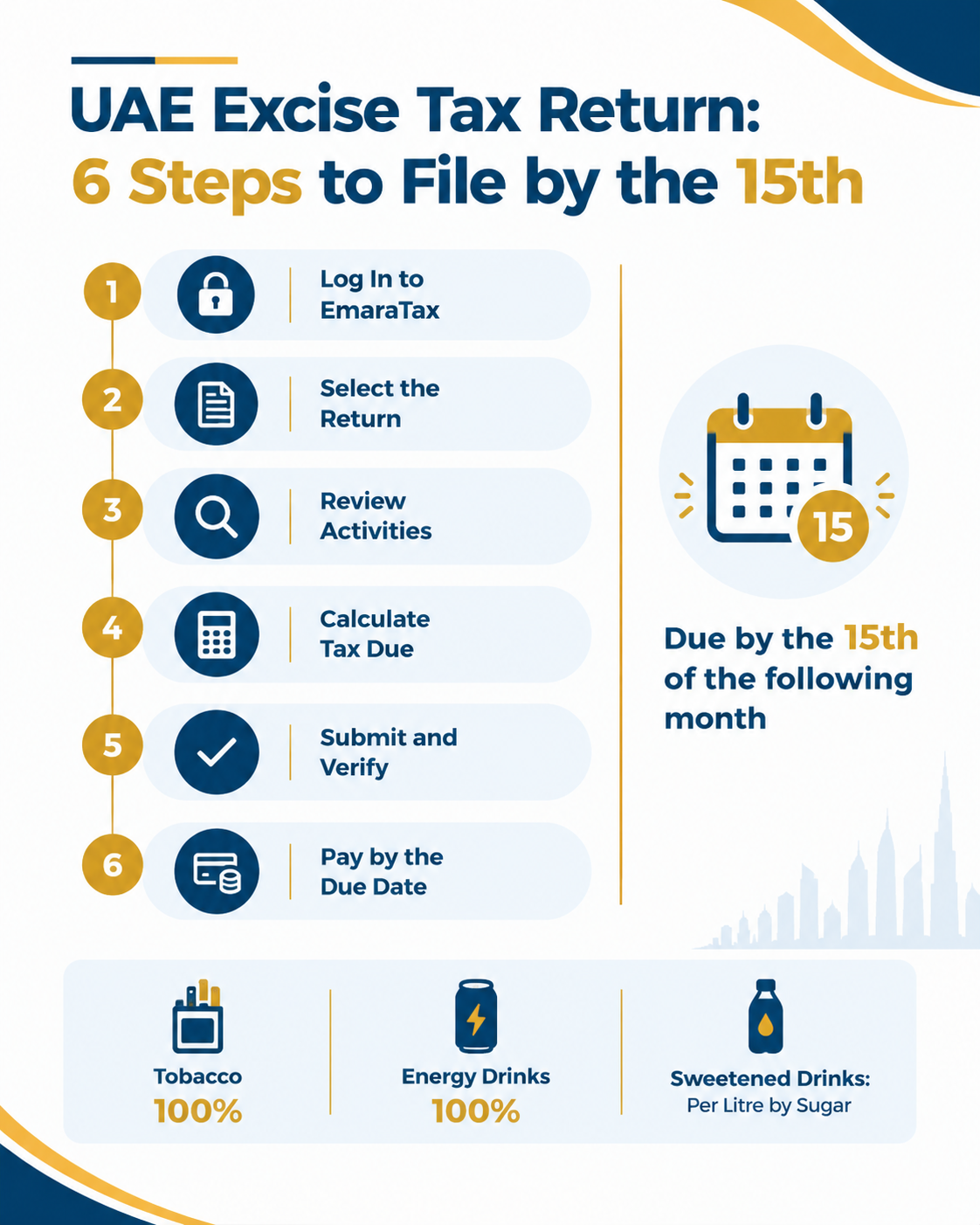
Step 1: Log In to the FTA’s EmaraTax Portal
Sign in to EmaraTax through the FTA website with your registered credentials. If you use a tax agent, they can access your account with the authority you have given them.
Step 2: Select the Relevant Excise Tax Return
Open your Excise Tax dashboard and choose the return for the tax period you are filing. Check the period dates at the top before going further. Selecting the wrong period is an avoidable mistake.
Step 3: Review Sales, Imports and Other Taxable Activities
Enter or confirm the quantities for the period: goods imported, goods produced, goods released from a designated zone and any adjustments. Details from declarations you have already submitted may appear in the return, but check every figure against your own records and not just the screen.
Step 4: Calculate the Excise Tax Due
Work out the tax for each product category using the correct rate, as described in the next section. Compare the total with your own working paper. If the portal figure and your figure differ, find out why before you submit.
Step 5: Submit the Return and Verify the Details
Read the declaration, confirm the details are true and complete, and submit. Save the acknowledgement and reference number. A submitted return cannot simply be edited. Corrections after submission go through a voluntary disclosure, so the check you do before pressing submit matters.
Step 6: Pay the Excise Tax Liability by the Due Date
Pay through EmaraTax by the same 15th-day deadline. Do not assume the payment has landed because you sent it. Confirm that it has been credited, and keep the receipt with the return. If you leave payment to the last hour, a banking delay can turn a filing on time into a late payment.
How to Calculate Excise Tax Payable in the UAE
The calculation depends on the product. Percentage-based goods are taxed on a price. Sweetened drinks are taxed on volume.
Understanding UAE Excise Tax Rates
For tobacco, electronic smoking devices, their liquids and energy drinks, the rate is 100% of the excise price, which is linked to the retail price registered with the FTA.
For sweetened drinks, the tax is a fixed amount per litre, set by sugar content, as shown in the table earlier.
Here is a worked example for a drinks importer’s monthly return. Suppose it releases 20,000 litres of a drink with 9g of sugar per 100 ml, 12,000 litres of a drink with 6g per 100 ml, and 8,000 litres of a drink with 3g per 100 ml.
- 20,000 litres at AED 1.09 = AED 21,800
- 12,000 litres at AED 0.79 = AED 9,480
- 8,000 litres at AED 0 = AED 0
The excise tax due for the month is AED 31,280. The same drinks would have been taxed very differently under the old 50% model, which is why an old template can produce a wrong answer.
Factors That Affect Excise Tax Calculations
- The product category and its rate
- The sugar content tier, for sweetened drinks
- The registered price, for percentage-based goods
- Quantities imported, produced or released in the period
- Exports and goods held in a designated zone, which are treated separately
- Any permitted adjustments, refunds or corrections from earlier periods
Common Excise Tax Calculation Mistakes
The most frequent errors are using the pre-2026 rate for sweetened drinks, applying the wrong sugar tier, calculating on the wrong price, mixing up litres and units, and counting goods in the wrong period. Another is keeping the working only in someone’s head. If the person who did the calculation leaves, nobody can explain the number.
Common UAE Excise Tax Return Filing Mistakes to Avoid
Submitting Returns After the Deadline
The deadline is the 15th, not the end of the month. Businesses used to the 28-day VAT window often assume they have longer. Put the excise date in the calendar for every month, with an internal deadline a few days earlier.
Reporting Incorrect Taxable Values
A wrong quantity, a wrong sugar tier or a stale price flows straight into the tax figure. Reconcile the return to stock movements and import records before submitting, not after.
Failing to Maintain Supporting Documents
If you cannot produce the import documents, production records or evidence for an export, a position that was right on the day can still fail on review. Keep documents with the return they support.
Overlooking Adjustments, Refunds or Eligible Exemptions
Exports outside the GCC, goods in a designated zone and some corrections can reduce what you pay, but only when you can prove them. Businesses that never claim what they are entitled to lose money quietly. Businesses that claim without evidence invite questions. The answer to both is the same: know the rule and keep the paperwork.
UAE Excise Tax Filing Penalties and Non-Compliance Risks
The penalty framework was revised by Cabinet Decision No. 129 of 2025, which took effect on 14 April 2026. PwC’s summary of the revised framework is a good independent reference. Amounts change from time to time, so verify the current figures with the FTA before you rely on them.
Penalties for Late Filing and Late Payment
A late return is generally AED 1,000 for the first failure and AED 2,000 for a repeat within 24 months. Late payment is now charged at 14% a year on the unpaid tax, accrued monthly from the day after the due date.
That replaced the old structure of 2% on the first day plus 4% a month. Failing to register on time is a fixed AED 10,000 penalty. There are also separate excise-specific penalties, for example for not giving the FTA the price lists of excise goods.
Consequences of Incorrect or Incomplete Returns
An incorrect return carries its own penalty, reduced under the revised framework to AED 500 for a first violation and AED 2,000 for a repeat. The bigger cost is usually the tax itself, plus the late payment charge on any shortfall once the FTA reassesses.
If you spot an error yourself, correct it through a voluntary disclosure. Under the revised framework, correcting before the FTA notifies you of an audit is charged at 1% a month on the tax difference, whereas an error the FTA finds first is penalised far more heavily.
How Businesses Can Reduce Compliance Risks
- Calendar the 15th with an internal deadline earlier in the month
- Reconcile the return to stock, imports and sales every month
- Review the rates and definitions each time the rules change
- Keep one named owner for the return, and a deputy
- Store supporting documents against the period they relate to
- Correct errors promptly through voluntary disclosure
Benefits of Professional UAE Excise Tax Filing Services
A monthly return is manageable for a business with a trained finance team. For most others, the combination of a short deadline, product-specific rates and recent rule changes makes outside support worth considering.
Accurate Tax Return Preparation and Submission
A specialist checks the product classification, the rate and the quantities before submission. That matters most where beverages are concerned, since one wrong sugar tier can distort the whole month.
Support with FTA Compliance and Documentation
Professional support covers registration, product registration, record-keeping standards and the correspondence that follows a query. If the FTA asks questions, you have someone who knows how to answer them.
Businesses that already use VAT services in Dubai often find it simpler to keep excise and VAT under one adviser, since the same sales data feeds both.
Saving Time and Reducing Administrative Errors
The monthly rhythm is the burden. Moving it to a team that does this every month frees your own people for the work that earns revenue, and cuts the risk of a missed deadline. It is the same build-or-outsource question growing businesses face with finance leadership generally, and our comparison of in-house vs outsourced CFO costs in Dubai shows how to weigh it.
Frequently Asked Questions About UAE Excise Tax Return Filing
Is UAE excise tax return filing mandatory for registered businesses?
Yes. Once you are registered, you must file a return for every tax period by the deadline, including periods where nothing is payable. Registration, not turnover, is what creates the obligation.
What is the filing frequency for UAE excise tax returns?
Monthly in the standard case. The tax period is one calendar month and the return is due by the 15th of the following month, unless the FTA has assigned a different period to your business.
Can I amend an excise tax return after submission?
Not by editing it. Once submitted, a return is corrected through a voluntary disclosure on EmaraTax. The FTA’s Voluntary Disclosure User Guide for VAT and Excise Tax explains the process. Act as soon as you find the error, because disclosing before the FTA contacts you is treated far more favourably.
How do I check the status of my excise tax return?
Log in to EmaraTax and open your Excise Tax account, where submitted returns and payments are shown. Keep the acknowledgement and reference number from each submission, and check that the payment has been credited and not just initiated.
What should I do if I cannot pay my excise tax by the deadline?
File the return on time anyway, since a late return is a separate penalty. Pay as much as you can by the deadline, and contact the FTA to ask whether a payment arrangement is possible. Remember that unpaid tax accrues a charge every month, so the longer it is outstanding, the more it costs.
Can an accounting firm help with UAE excise tax filing?
Yes. An accounting firm can prepare the return, check classification and rates, keep the records in order and handle FTA queries. It is most useful where the business is new to excise, imports regularly, or sells drinks affected by the 2026 changes.
Get Professional Assistance with UAE Excise Tax Return Filing
A monthly return that goes in right, on time, every time, is mostly a matter of good records and a reliable routine. Al Burhan Accounting and Taxation can help your business with excise tax return preparation, filing, recordkeeping and ongoing compliance support, so the 15th stops being a source of stress.
Book a consultation to go through your excise obligations and set up a filing routine that works.
More Insights