Accounting Firm in Dubai — Tax, VAT & Audit Services UAE | Al Burhan

UAE E-Invoicing Mandate: Deadlines, Requirements and How to Prepare
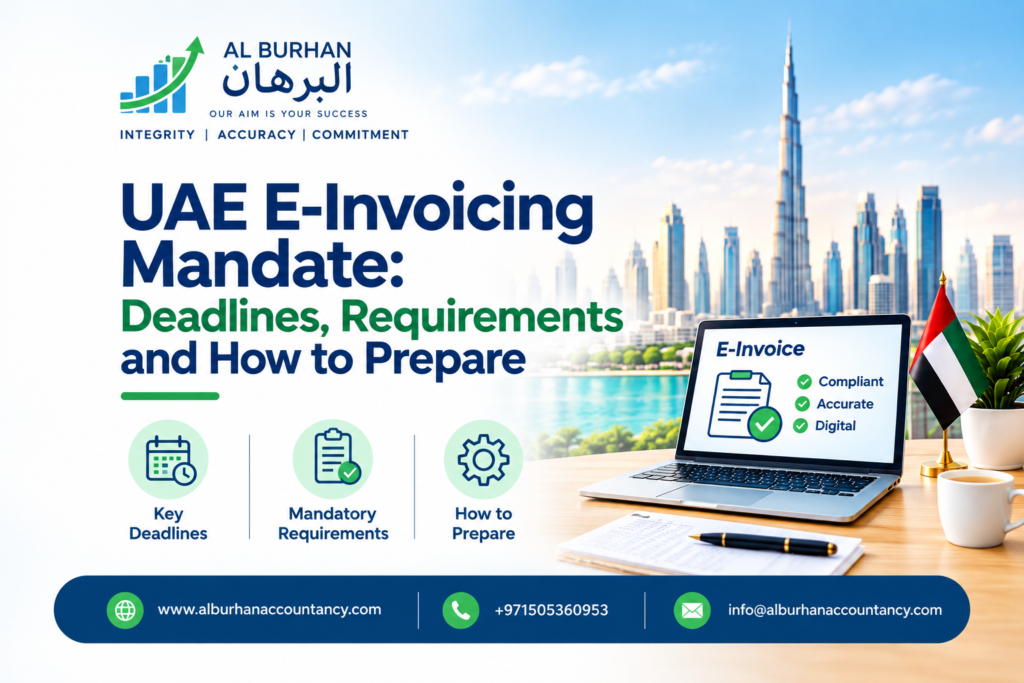
The UAE e-invoicing deadline is closer than many businesses think. If your company earns AED 50 million or more a year, you have until 30 October 2026 to appoint an approved service provider, and your e-invoicing must be live on 1 January 2027.
Smaller businesses and government entities get more time, but the work takes longer than most people expect.
This guide explains the UAE e-invoicing mandate in plain language. You will see what changes, which deadline applies to you, what the rules require, and how to get ready step by step.
Dates and rules were checked in October 2026. The Ministry of Finance can update them, so always confirm the latest position before you act.
What Is the UAE E-Invoicing System?
The UAE electronic invoicing system is a national system where businesses send invoices to each other as structured digital data, not as paper or PDF files.
The data travels through approved providers, and the tax details are also reported to the Federal Tax Authority (FTA).
Two Ministerial Decisions set it up. Decision No. 243 of 2025 sets out how the system works. Decision No. 244 of 2025 sets the phases and dates. Deloitte’s summary of the e-invoicing legislation is a good place to read more about both.
How is an e-invoice different from a PDF?
A PDF invoice is a picture of an invoice. A person has to read it and type the numbers into their own system. An e-invoice is a data file, usually in XML format, that software can read by itself. The supplier’s system creates it. The buyer’s system receives it. Nobody retypes anything.
That is why, for the businesses and transactions in scope, a PDF emailed to a customer will no longer count as a valid tax invoice. The invoice has to be sent as structured data through the approved network.
UAE E-Invoicing Deadline 2026–2027: Latest Implementation Timeline
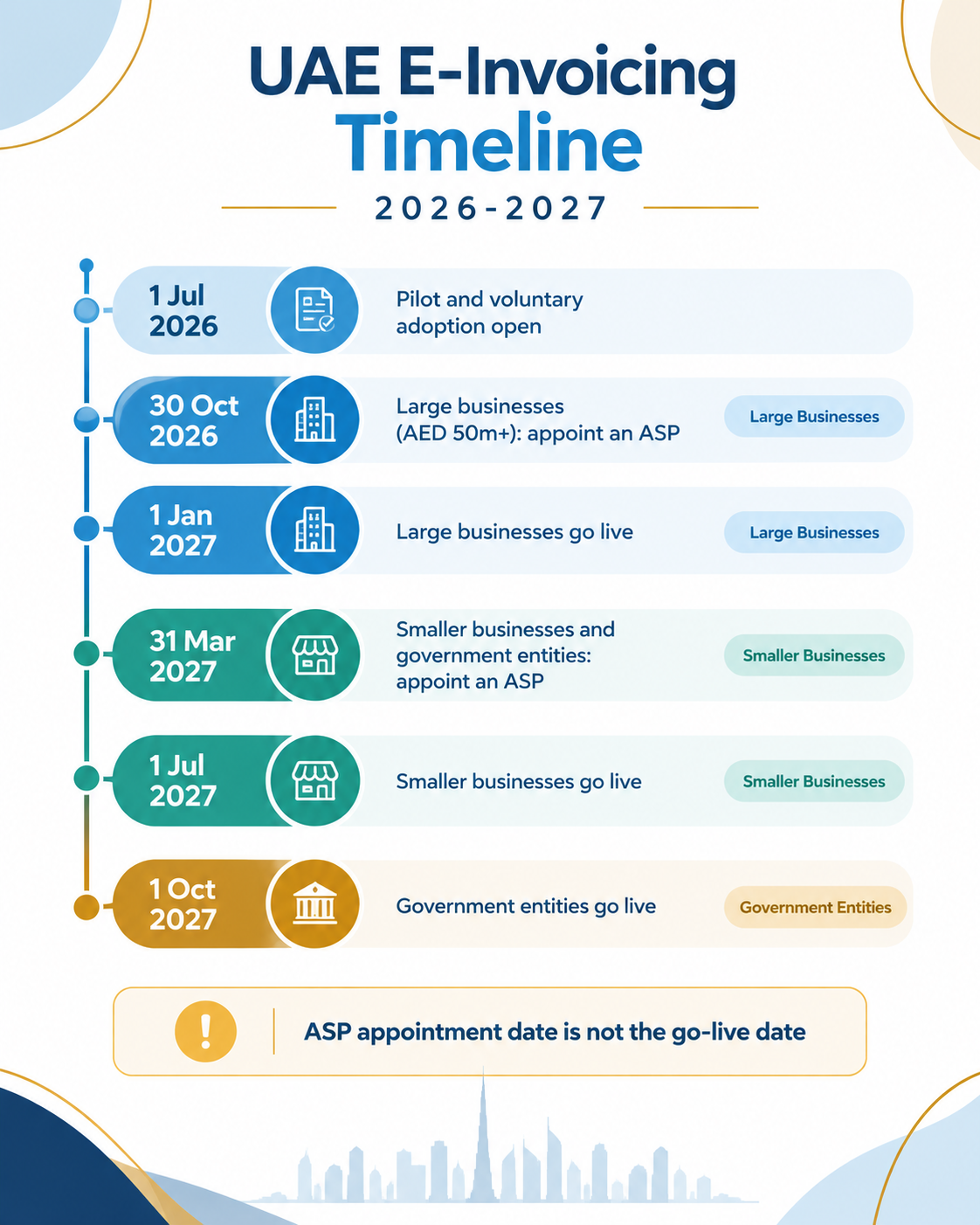
Every business has two dates to track. The first is the date by which you must appoint an Accredited Service Provider, or ASP.
The second is the mandatory go-live date, when you must actually issue e-invoices. People often mix these up, and the difference matters.
An ASP is a technology company approved by the Ministry of Finance. It connects your accounting system to the e-invoicing network, checks your invoices, sends them to your customer’s provider, and reports the tax data to the FTA.
| Group | Appoint an ASP by | Mandatory go-live |
| Pilot and voluntary adopters | Opened 1 July 2026 | Voluntary |
| Businesses with annual revenue of AED 50 million or more | 30 October 2026 | 1 January 2027 |
| Businesses with annual revenue below AED 50 million | 31 March 2027 | 1 July 2027 |
| Government entities | 31 March 2027 | 1 October 2027 |
UAE E-Invoicing Deadline for Large Businesses
If your annual revenue is AED 50 million or more, you are in the first group. You must appoint an ASP by 30 October 2026. You must start issuing e-invoices by 1 January 2027.
That leaves only about two months between the ASP deadline and go-live. In those two months you need to connect your system, map your data, test and train your team.
A business that signs with a provider on the last day will be in a hurry. If you are near the AED 50 million line, check how the Ministry measures annual revenue so you know which group you belong to.
UAE E-Invoicing Deadline for SMEs and Smaller Businesses
If your annual revenue is below AED 50 million, you are in the second group. You must appoint an ASP by 31 March 2027, and your mandatory go-live date is 1 July 2027.
This gives smaller businesses more time, and that is useful. But it is not a reason to wait. Providers will be busy once the first group goes live, and the later you start, the less choice you may have.
You can also join early. Voluntary adoption has been open since 1 July 2026, and voluntary users are not subject to the e-invoicing penalties.
One warning: do not confuse the AED 50 million e-invoicing line with other revenue limits. The AED 3 million limit for Small Business Relief extended to 2029 is a Corporate Tax test, and it has nothing to do with which e-invoicing deadline applies to you.
UAE E-Invoicing Deadline for Government Entities
In-scope government entities follow the same appointment date as smaller businesses, 31 March 2027, and go live on 1 October 2027.
If your business sells to government bodies, remember that invoices to government (B2G) are part of the system too. Check how both your own date and your customer’s date apply to you, so you are not caught out.
Has the UAE E-Invoicing Deadline Been Extended?
Yes, but only in one narrow way. On 10 May 2026, the Ministry of Finance extended the date to appoint an ASP for businesses with annual revenue above AED 50 million. The date moved from 31 July 2026 to 30 October 2026.
The go-live date did not move. It is still 1 January 2027. So the extension did not give large businesses more time to be live. It gave them three more months to choose a provider, which actually shortens the gap between signing and going live.
Here is the simple way to read any update you see online:
- An ASP appointment extension only moves the date to choose a provider.
- An implementation extension moves the date you must issue e-invoices.
So far, only the first kind has been announced, and only for the large business group. Be careful with articles that say “the deadline has been extended” without saying which deadline.
Before you plan around any change, check the Ministry of Finance’s own announcements and confirm that the update covers your group.
UAE E-Invoicing Requirements for Businesses
The core rules are simple to state. You issue invoices and credit notes in a set digital format, you send them through an accredited provider, and the tax data reaches the FTA. Here is what each part means.
Which transactions are covered? The system applies to business-to-business (B2B) and business-to-government (B2G) transactions. Sales to ordinary consumers (B2C) are outside the current phase, although the Ministry has said this may be addressed later.
According to current guidance, businesses that are not VAT registered but sell to other businesses are still in scope, and free zone companies are generally covered too. Some activities, such as certain sovereign government acts, are excluded, so check your own position.
Electronic Invoice Format and Data Requirements
UAE e-invoices must follow a format called PINT AE. This is a structured XML format based on the international Peppol and UBL standards, with extra fields for UAE needs.
The format asks for around 50 mandatory data fields. They include things like:
- The supplier’s and buyer’s names, addresses and Tax Registration Numbers (TRNs)
- The invoice number and date
- A description of the goods or services
- Quantities, prices and discounts
- The VAT category and VAT amount
- The total amount
The key point is accuracy. The system checks the data. If a required field is missing or wrong, the invoice can be rejected.
The documents covered include tax invoices, credit notes and self-billed invoices. For export invoices, the data must be reported, but they are not sent over the network to the buyer in the same way.
Accredited Service Provider Requirements
You cannot connect to the e-invoicing system on your own. You must use an ASP from the Ministry of Finance’s list of accredited providers. The Ministry publishes that list, so only choose from it.
When you compare providers, ask practical questions:
- Does it work with your accounting or ERP system, or will you need a custom connection?
- How much does it cost, and is the price based on invoice volume?
- How does it handle errors and rejected invoices?
- What support is available, and in which hours?
- How will it help you test before go-live?
- Can it handle both the invoices you send and the ones you receive?
Your ASP is a long-term partner, not a one-off purchase. If you change your registered business details, you must tell your ASP, and failing to do so on time can be fined.
Peppol and UAE E-Invoicing Network Requirements
The UAE system runs on the Peppol network, which is an international network for exchanging digital invoices. The UAE adds one more party, the FTA, so it is often called the five-corner model. In simple terms:
- Corner 1: The seller creates the invoice in its own system.
- Corner 2: The seller’s ASP checks the invoice, converts it to the correct format and sends it on.
- Corner 3: The buyer’s ASP receives the invoice.
- Corner 4: The buyer gets the invoice in its own system.
- Corner 5: The FTA receives the tax data from the seller’s ASP.
You do not need to learn how the network works inside. But you should know that the invoice no longer goes straight from you to your customer. It goes through two providers, and the tax data is shared with the authority at the same time.
E-Invoicing and VAT Compliance in the UAE
E-invoicing does not replace VAT. It is a new way of delivering the invoices that VAT is based on. Your invoices must still meet the normal VAT rules: the correct TRN, the right tax treatment, the right amounts, and proper credit notes when you adjust a sale.
The change is that the FTA will see invoice data as it happens. This is likely to make mismatches between your invoices and your VAT return easier to spot. If an invoice says one thing and your return says another, someone may ask why.
The same goes for businesses that sell excise goods, because the sales records behind your monthly return, covered in our guide to UAE excise tax return filing, should match the invoices you issue.
Businesses that keep clean records and reconcile their VAT regularly will be in a much better position. Clean coding at invoice level is the best defence, and our VAT services team can help you review yours.
Alt text: Timeline infographic of the UAE e-invoicing deadlines from July 2026 to October 2027, showing the ASP appointment date and go-live date for large businesses, smaller businesses and government entities
How to Prepare for Mandatory E-Invoicing in the UAE
You do not need to be a technology expert to prepare. You need a clear plan and enough time. KPMG’s guidance on UAE e-invoicing readiness is worth reading alongside the steps below. Treat this as a project with an owner, not as a task for one person in the finance team.
Review Your Current Accounting and Invoicing System
Start by asking whether your accounting software can produce e-invoices in the required format, or connect to an ASP. Some systems can do this already or through an add-on. Others cannot, and you may need to upgrade or replace them.
Write down how invoices are created today, who approves them, where they are stored, and how credit notes are handled. If you are thinking about a change, choose a system that supports e-invoicing directly or through a supported provider.
Check Your Business and Customer Data
E-invoices rely on clean data. Check your customer and supplier records. Do you have the correct names, addresses and TRNs? Are your product descriptions and tax categories consistent?
Messy master data is the most common cause of rejected invoices, and it is much cheaper to fix before go-live than during it. Good accounting and bookkeeping habits make this step far easier.
Select an Accredited Service Provider
Use the Ministry’s list and compare at least two or three providers using the questions earlier in this guide. Ask for a demonstration with your own type of invoice.
Check the contract for fees, support and what happens if you want to switch later. If you are in the first group, remember the 30 October 2026 date.
Update Accounting Software and Business Processes
Once you have a provider, connect it to your system and map your data fields to the required format. Update your process too. Decide who creates invoices, who fixes rejected ones, and who deals with the ASP. Decide how you will handle credit notes, corrections and cancellations in the new setup.
Test Electronic Invoice Generation and Exchange
Do not go live on day one without testing. Send test invoices, including awkward ones: discounts, credit notes, foreign currency, zero-rated sales and different tax categories. Check that the data is correct at the other end. Fix every error you find before real customers see it.
Train Employees and Establish Internal Controls
Train everyone who touches invoices, not just the finance team. Sales staff who raise invoices, accounts staff who check them and managers who approve them all need to know the new process.
Set simple controls, such as a daily check for rejected invoices and a named person who tells the ASP about changes to your business details.
How UAE E-Invoicing Will Affect SMEs and Large Businesses
The change touches invoicing workflows, accounting teams, record-keeping and technology costs. How much it affects you depends on your size and how you work today.
Large businesses have high invoice volumes and complex systems, often with several ERP platforms or entities. Their challenge is integration. They need to connect existing systems, handle large volumes reliably, and coordinate between finance, IT and sales.
Group structures add another layer. Invoices between related companies are business-to-business invoices too, so check how they are treated, and keep the same records ready for the connected persons rules under UAE Corporate Tax. They face the earliest deadline, so they feel the time pressure most.
SMEs and smaller businesses usually have simpler systems but smaller teams. Their challenge is capacity and cost. They may need to replace older software, pay for a provider, and train staff who already have full workloads. The later deadline helps, but only if they use the extra time well.
For both groups, expect these changes:
- Invoicing workflow: invoices are created as data, checked automatically and sent through the ASP.
- Accounting teams: less retyping and fewer manual checks, but more attention to data quality and rejected invoices.
- Transaction processing: faster delivery, but errors are caught at the start instead of later.
- Record-keeping: invoices must be stored in the required format, and you must be able to retrieve them for the period the rules require.
- Costs: these can include provider fees, software changes or upgrades, set-up and testing, training, and internal time. Prices vary widely, so get quotes and compare.
Common UAE E-Invoicing Implementation Mistakes to Avoid
Most problems can be avoided with early planning. These are the mistakes that come up most often.
- Choosing an ASP too late. The best providers fill up. Leaving it to the last week limits your options and your testing time.
- Relying on an outdated accounting system. If your software cannot produce the right format, you will find out too late if you do not check early.
- Using inaccurate master data. Wrong TRNs, missing addresses and inconsistent tax categories lead to rejected invoices.
- Not testing enough. Testing only simple invoices hides the problems that appear with credit notes, discounts and special cases.
- Mixing up the deadlines. The ASP appointment date and the go-live date are different. The extension for large businesses moved only the first one.
- Treating it as an IT project. Sales, finance and management all need to be involved, because invoices touch every part of the business.
- Forgetting to report changes. If your registered data changes and you do not tell your ASP on time, you can be fined.
UAE E-Invoicing Penalties and Compliance Risks
The penalties come from Cabinet Decision No. 106 of 2025. They apply to businesses that are required to use the system. Voluntary adopters and pilot participants are not fined during those periods. The main penalties are:
| Violation | Penalty |
| Not implementing the system, including not appointing an ASP on time | AED 5,000 for each month or part of a month |
| Not issuing and sending an e-invoice on time | AED 100 per invoice, capped at AED 5,000 per month |
| Not issuing and sending an e-credit note on time | AED 100 per credit note, capped at AED 5,000 per month |
| Not notifying the FTA of a system failure on time | AED 1,000 per day |
| Not notifying your ASP of changes to your registered data on time | AED 1,000 per day |
These are in addition to the normal VAT penalties. Our guide to VAT penalties in the UAE shows how those work. Penalty rules and amounts can change, so check the official text before you rely on any figure.
The money is only part of the risk. Invoices that are rejected or late can delay payments from customers, and a business that cannot issue valid e-invoices may struggle to trade with larger customers who insist on them.
Frequently Asked Questions About UAE E-Invoicing
When Does Mandatory E-Invoicing Start in the UAE?
It starts in phases. For businesses with annual revenue of AED 50 million or more, it starts on 1 January 2027. For businesses below AED 50 million, it starts on 1 July 2027. For in-scope government entities, it starts on 1 October 2027. A pilot and voluntary period opened on 1 July 2026.
Has the UAE E-Invoicing Deadline Been Extended?
Only the deadline to appoint an ASP has been extended, and only for businesses with annual revenue of AED 50 million or more. It moved from 31 July 2026 to 30 October 2026. The mandatory go-live date of 1 January 2027 did not change. Check the Ministry of Finance for any newer announcement.
Is E-Invoicing Mandatory for All Businesses in the UAE?
It is mandatory for in-scope businesses and government entities for B2B and B2G transactions, from the date that applies to their group. This includes businesses that are not VAT registered. Sales to individual consumers (B2C) are outside the current phase, and a few activities are excluded. Check your own position against the Ministry’s rules.
What Is the Deadline to Appoint an ASP in the UAE?
For businesses with annual revenue of AED 50 million or more, it is 30 October 2026. For businesses below AED 50 million and for government entities, it is 31 March 2027.
How Does E-Invoicing Affect VAT-Registered Businesses?
Your VAT rules do not change, but your invoices must now be issued as structured data through an ASP, and the tax data goes to the FTA as it is created. That makes it more important that your invoices, credit notes and VAT returns match. Clean records and regular reconciliation are the best protection.
How Can a Small Business Prepare for UAE E-Invoicing?
Start early, even though your deadline is later. Check whether your accounting software can produce e-invoices. Clean your customer and supplier data. Compare providers from the Ministry’s list. Test with real examples before go-live, and train your staff. If you keep your books with an outside accountant, ask them how they plan to support the change.
Conclusion: Prepare Your Business for the UAE E-Invoicing Mandate
The most important thing is to know which dates apply to you. Large businesses must appoint an ASP by 30 October 2026 and go live on 1 January 2027. Smaller businesses must appoint by 31 March 2027 and go live on 1 July 2027.
Government entities follow on 1 October 2027. After that, the steps are the same for everyone: review your system, clean your data, choose a provider, test carefully and train your people.
If you want help, Al Burhan Accounting and Taxation supports businesses in Dubai with accounting, bookkeeping and tax consultancy. We can review your current accounting systems, tidy your records and help you prepare for e-invoicing alongside your VAT and Corporate Tax obligations.
Book a consultation to find out which deadline applies to you and what you need to do before it arrives.