Accounting Firm in Dubai — Tax, VAT & Audit Services UAE | Al Burhan

UAE Corporate Tax and Connected Persons: Rules for Owners, Directors and Related Parties

If you own a UAE business, pay a director a salary, rent office space from a shareholder, or run a group of companies under common ownership, the connected persons rules under UAE corporate tax already apply to you, whether you have looked into them yet or not. Most owner-managed businesses in the UAE have at least one transaction that falls into this category, and getting the classification wrong is one of the more common reasons the Federal Tax Authority ends up denying a deduction.
The confusion usually starts with terminology. Related parties and connected persons sound like they mean the same thing, and in casual conversation people often use them interchangeably. Under the law, they are not the same. Related parties are defined by ownership and control under Article 35.
Connected persons are a narrower group built around a person’s role, owners, directors, and officers, plus anyone closely tied to them, defined under Article 36. The distinction matters because the rules that apply to each group are not identical, and mixing them up can lead to missed disclosures or payments that get flagged during a review.
This article breaks down both categories in plain terms, walks through the arm’s length pricing requirement that governs payments between them, and covers the disclosure thresholds that determine when a business actually needs to report these transactions to the FTA. If you are working through this alongside a broader review of your filings, it fits naturally into a wider corporate tax advisory process rather than something handled in isolation.
What Are Connected Persons Under UAE Corporate Tax Law
Connected persons, under Article 36 of the UAE Corporate Tax Law, are a specific group of individuals with a close relationship to a taxable person. This includes the owner of the business, its directors and officers, and any person related to those individuals within the fourth degree of kinship or affiliation, whether by birth, marriage, adoption, or guardianship.
A related party of any of these people is also treated as a connected person. If the taxable person is a partner in an unincorporated partnership, every other partner in that partnership counts too.
The reason this category exists is fairly practical. A business owner can move profit out of a company in ways that a straightforward income statement will not catch, paying themselves an inflated salary, charging the company rent above market rate, or paying a relative for a role they barely perform.
None of these transactions look unusual on their own. Grouped together and measured against a market value standard, they start to reveal whether reported profit reflects economic reality or just a convenient way to shift taxable income around.
It is worth being clear that most connected person transactions are entirely legitimate. Owners lease property to their own companies, directors take a market rate salary, and group companies share services all the time. The rule is not an assumption of wrongdoing. It exists so the FTA has visibility into these relationships and can apply the arm’s length test where it actually matters.
Related Parties and Connected Persons UAE: Key Differences
These two terms get used loosely, but the law separates them by different logic.
Related parties, under Article 35, are defined by ownership, control, or kinship. Two people are related parties if they are connected within the fourth degree of kinship, if one person alone or with family owns or controls at least 50 percent of a business, or if two businesses are connected because one owns or controls at least 50 percent of the other, or because the same person owns or controls both.
The definition also extends to a company and its permanent establishment, partners in the same unincorporated partnership, and a trust or foundation along with anyone tied to it, including trustees, founders, or beneficiaries.
Connected persons, under Article 36, are narrower. They are specifically the owner, director, or officer of a taxable person, plus anyone related to those individuals, rather than the full web of ownership and control relationships that Article 35 covers.
| Aspect | Related Parties (Article 35) | Connected Persons (Article 36) |
| Basis of definition | Ownership, control, kinship | Role: owner, director, officer, plus their related parties |
| Scope | Broad, covers companies and individuals | Narrower, tied to a specific taxable person |
| Typical example | Two sister companies under common ownership | A director’s salary, or rent paid to a shareholder |
| Governing article | Article 35 | Article 36 |
Article 35 UAE Corporate Tax: Who Counts as a Related Party
Ownership and control sit at the center of Article 35. A person, alone or together with related parties, is treated as controlling another person if they can exercise 50 percent or more of the voting rights, determine the composition of 50 percent or more of the board of directors, or receive 50 percent or more of the profits of that other person.
A fourth test sits alongside these three, the ability to exercise significant influence over another person’s conduct or affairs, which is a broader standard than a fixed percentage and gives the FTA room to capture control arrangements that do not fit neatly into a voting rights or board seat count. Control does not require holding shares directly.
A shareholder who holds a minority of shares but has the contractual right to appoint the majority of the board is still considered to have control, since the ability to shape board composition carries the same weight as majority ownership under the law.
The fourth degree of kinship UAE tax rule is wider than most business owners assume. It is measured in degrees of relationship rather than by household, and it reaches beyond a spouse and children to cover parents, grandparents, siblings, and more distant relatives depending on how the degree is counted.
Two people who are related within this range are automatically related parties, regardless of any business connection between them.
The article also brings in a few less obvious categories. A company and its permanent establishment, whether inside or outside the UAE, are treated as related parties. So are partners in the same unincorporated partnership, and a trust or foundation together with its trustees, founders, or beneficiaries.
Indirect ownership counts too, so a chain of companies each holding a stake in the next can still trigger the 50 percent threshold once the ownership percentages are combined across the chain.
Article 36 UAE Corporate Tax: Owners, Directors and Officers as Connected Persons
Article 36 narrows the focus to a taxable person’s own leadership and ownership structure, along with the people close to them.
Owner and Officer Connected Person Criteria
An owner, under Article 36, is any natural person who directly or indirectly holds an ownership interest in the taxable person or exercises control over its operations.
This is a broad standard. It does not require a majority stake, only an ownership interest or a genuine ability to influence how the business runs. Directors and officers are covered in the same way, regardless of whether they also hold shares.
Director Compensation and Corporate Tax Treatment
Payments to directors, whether salary, bonuses, pension contributions, or other benefits tied to their role, fall under the connected persons rules. These payments remain deductible, but only up to market value, and only where they are genuinely incurred wholly and exclusively for business purposes.
A director’s compensation that sits noticeably above what an unrelated person would be paid for the same role and responsibilities risks having the excess portion disallowed as a deduction, which raises the company’s taxable income.
Kinship and Family Members as Connected Persons
Close family members of an owner, director, or officer, generally covering relationships up to the fourth degree by blood or marriage, are treated as connected persons in their own right. A relative who receives consulting fees, a salary, or any other payment from the business qualifies as a connected person because of their relationship to the owner or director, not because of any direct role they hold in the company.
This is one of the areas businesses most often overlook, since a payment to a family member for work that appears legitimate can still trigger disclosure and pricing obligations simply because of the family connection.
Unincorporated Partnership Connected Persons Rules
Where the taxable person is a partner in an unincorporated partnership, every other partner in that same partnership is automatically treated as a connected person. This applies regardless of each partner’s individual ownership share, so even a partner holding a small stake in the partnership falls under the same rules as a majority partner.
Arm’s Length Principle UAE: Why Market Value Payments Matter
The arm’s length principle UAE corporate tax law applies is the standard that runs through nearly every related party and connected person rule.
Put simply, a transaction between connected parties needs to be priced as if it happened between two unrelated businesses negotiating independently, not shaped to produce a particular tax outcome.
This connects directly to the UAE’s broader transfer pricing UAE framework. Payments or benefits provided to related parties or connected persons must reflect market value, supported by evidence such as market comparables, salary benchmarks, or third party quotes.
A management fee charged between group companies, a loan between sister businesses priced at a below market interest rate, or rent paid to a shareholder above what similar property would command in the open market are all examples where the arm’s length test applies directly.
If a payment fails this test, the consequence is not a warning. The FTA can deny the deduction outright, which increases the taxable base of the business making the payment.
Depending on the recipient’s own tax position, the same amount can also be taxed in their hands, creating a form of double taxation that a properly priced and documented transaction would have avoided entirely.
Connected Persons Threshold UAE Corporate Tax
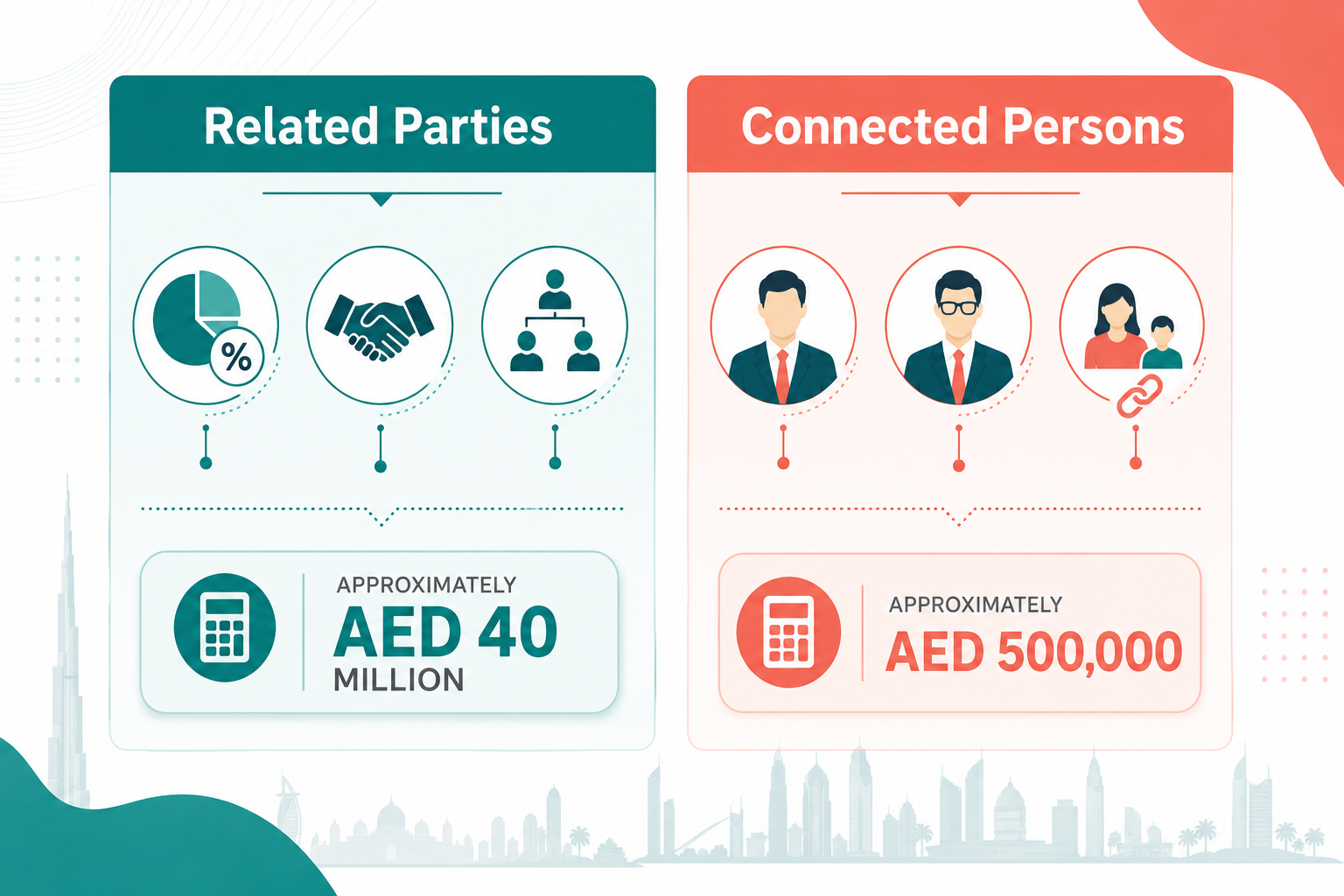
Not every connected person transaction requires the same level of disclosure, and the threshold that triggers a reporting obligation is lower than many owner-managed businesses expect. Under the FTA’s Corporate Tax Guide, a Connected Persons Schedule must be completed once the aggregate value of payments or benefits to a single connected person, including that person’s own related parties, exceeds AED 500,000 in a tax period.
That figure covers salaries, rent, interest, and other benefits added together, which means a business paying an owner’s rent, a director’s salary, and a relative’s consulting fee can cross the line without any single payment looking unusual on its own.
Related party disclosure sits on a separate, higher threshold. A Related Party Transaction Schedule is required once the aggregate value of all transactions with all related parties, as recorded in the financial statements or at market value, exceeds AED 40 million in the tax period.
Once that threshold is crossed, disclosure is only required for individual categories, such as goods, services, intellectual property, interest, or assets, where each category itself exceeds AED 4 million.
A specific exclusion applies to the connected persons deductibility limitation, though not to every related party rule. It covers a taxable person whose shares are traded on a recognized stock exchange, a taxable person subject to the regulatory oversight of a competent authority in the UAE, and any other person the Cabinet may determine in a future decision.
Because FTA guidance continues to evolve, businesses should confirm these figures against the current FTA Corporate Tax Guide or a qualified tax advisor before relying on them for a filing, rather than treating any single blog post, including this one, as the final word.
Related Party Transaction Disclosure Requirements UAE
Once a business crosses the relevant threshold, it needs to complete a related party or connected persons schedule as part of its corporate tax return, disclosing the nature of the relationship, the type of transaction, and its value.
This is separate from simply keeping internal records. The disclosure needs to be accurate and complete at the point of filing, not reconstructed afterward if the FTA asks a question.
Getting this wrong carries real consequences. Beyond a denied deduction, incomplete or inaccurate related party disclosure can result in an incomplete corporate tax return, which creates its own compliance exposure separate from any dispute over pricing.
On top of that, late submission of transfer pricing documentation, including the disclosure form itself, has been cited at a AED 10,000 penalty, with further penalties possible where the information provided turns out to be inaccurate or incomplete.
Businesses that treat this as a checkbox exercise, rather than an accurate reflection of their actual relationships and transactions, tend to be the ones that run into trouble during a review.
Tax Grouping and Related Parties in the UAE
Related party status is not only a disclosure concern. It also opens the door to forming a tax group, which lets related UAE entities file and pay corporate tax as a single unit rather than separately.
To qualify, a UAE resident parent company must directly or indirectly hold at least 95 percent of the share capital, voting rights, and entitlement to profits and net assets of each subsidiary joining the group.
The parent and subsidiaries also need to share the same financial year and apply the same accounting standards, and neither party can be an exempt person or a Qualifying Free Zone Person.
Once formed, the parent company takes on responsibility for filing one consolidated return and settling the tax liability for the whole group, rather than each entity filing separately.
It is worth noting that a group’s composition for corporate tax purposes does not automatically match its VAT group composition, since the two sets of grouping rules differ, so businesses running both need to assess each separately through their VAT services provider rather than assuming one grouping decision covers both taxes.
Transfer Pricing Methods, Adjustments and Advance Pricing Agreements
Once a related party or connected person transaction is identified, the next question is how to actually test whether it meets the arm’s length principle. The UAE Corporate Tax Law sets out five transfer pricing methods, broadly aligned with the OECD Transfer Pricing Guidelines, and requires businesses to select whichever method best fits the transaction based on factors like contractual terms, the characteristics of the transaction, economic circumstances, the functions and risks involved, and overall business strategy.
Where none of the five prescribed methods can reasonably be applied, a business is permitted to use another method instead, provided it can justify that choice. The FTA’s own Transfer Pricing Guide walks through how these methods apply specifically to UAE taxable persons, and is worth reading directly for anyone selecting a method for the first time.
If the FTA determines that a transaction between related parties falls outside the arm’s length range, it can adjust the taxable income of the business involved. Where that happens, a corresponding adjustment is generally made to the taxable income of the other party to the same transaction, so the same profit is not taxed twice within the UAE.
Where a foreign tax authority makes the adjustment instead, a UAE taxable person can apply for corresponding adjustment relief, though the exact mechanism for this is still developing.
Businesses that want certainty on a specific transaction ahead of time can apply for an Advance Pricing Agreement, confirming the FTA’s agreement to a proposed pricing approach before it is implemented. Domestic unilateral APAs opened for applications in December 2025, with cross-border unilateral APAs expected to follow.
Master File, Local File and Country by Country Reporting Thresholds
Not every business needs to prepare full transfer pricing documentation, only the disclosure form covered earlier. A Master File and Local File become mandatory where a taxable person is a constituent entity of a multinational group with total consolidated group revenue of AED 3.15 billion or more, or where the taxable person’s own revenue in the relevant tax period reaches AED 200 million or more.
Where either threshold is met, these files must be submitted within 30 days of an FTA request rather than automatically alongside the tax return.
A narrower exemption applies within the Local File requirement itself. Transactions with natural persons, and transactions with a juridical person that only counts as a related party or connected person because of a shared unincorporated partnership, can be left out of the Local File, provided both sides are acting as if they were genuinely independent of each other.
Country by Country Reporting applies at a different scale again, triggered only for UAE headquartered multinational groups with consolidated revenue above AED 3.15 billion, and due within 12 months of the end of the group’s reporting year.
Most owner-managed UAE businesses will never reach this threshold, but it matters for larger groups weighing where to headquarter a multinational structure.
Common Mistakes Businesses Make With Related Party Transactions UAE
A few patterns show up repeatedly among owner-managed businesses navigating this for the first time.
Paying a salary to a family member for a role they do not genuinely perform is one of the most common issues, since the payment looks like an ordinary business expense until the FTA asks what the person actually does.
A typical version of this looks harmless on paper, a UAE trading company owned by one parent pays a monthly consulting fee to their adult child for marketing support, and the fee only becomes a problem once someone asks what deliverables the arrangement actually produced.
Charging rent or management fees well above what the market would bear for comparable property or services is another, particularly among businesses that have not benchmarked these figures against anything external, a pattern that shows up just as often in cross-border management fees paid to a foreign parent company as it does in domestic rent arrangements. Missing documentation is the third recurring problem.
Round numbers with no supporting calculation, fee arrangements with no written scope, and backdated agreements are all red flags that make a legitimate transaction look manufactured, even when it was not.
How to Identify Related Parties and Prepare for Compliance
- Map every owner, director, officer, and their close family members connected to the business, along with any sister companies or joint ventures under common control.
- Tag each relationship clearly as a related party, a connected person, or both, since the disclosure rules differ.
- Price every in-group transaction at market value, supported by quotes, salary benchmarks, or comparable third party rates.
- Document the basis for each price, including the date, scope, and any approvals, in a short evidence file rather than relying on memory later, ideally in a format that would hold up during an audit rather than one assembled after the fact.
- Review compensation and pricing policies for owners, directors, and senior staff regularly, since market rates shift and a policy set two years ago may no longer hold up, a task many businesses hand to an outsourced CFO rather than revisiting it only once a year.
Frequently Asked Questions
Who is a connected person under UAE corporate tax?
A connected person is the owner, director, or officer of a taxable person, along with anyone related to them within the fourth degree of kinship, and any other partner if the taxable person is part of an unincorporated partnership.
What is the difference between a related party and a connected person?
Related parties are defined broadly by ownership, control, or kinship under Article 35. Connected persons are a narrower group tied specifically to a taxable person’s owners, directors, and officers, plus their relatives, under Article 36.
Is director salary a connected person payment?
Yes. Salaries, bonuses, and other benefits paid to a director are connected person payments and remain deductible only up to market value, provided they are incurred wholly and exclusively for business purposes.
Does the connected persons rule apply to small businesses?
Yes, the rule itself applies regardless of business size. What changes is the disclosure threshold, since smaller aggregate transaction values may not trigger a reporting requirement, though the pricing and deductibility rules still apply to the underlying payments.
Can related companies file one corporate tax return together?
Yes, related UAE entities can form a tax group and file a single consolidated return, provided the parent company holds at least 95 percent of the subsidiary’s share capital, voting rights, and profit entitlement, and both share the same financial year and accounting standards.
Final Takeaway
The connected persons and related party rules under UAE corporate tax are not designed to punish ordinary business arrangements between owners, directors, and their companies.
They exist to make sure those arrangements are priced honestly and disclosed clearly, so that reported profit reflects what actually happened rather than a number shaped by who was on each side of the transaction.
Businesses that map their relationships early, price transactions at market value, and keep a short paper trail tend to move through filing season without surprises. The ones that treat it as an afterthought are usually the ones explaining a denied deduction after the fact.
Get Corporate Tax Compliance Support With Al Burhan
Identifying every related party and connected person across an ownership structure, then pricing and documenting each transaction correctly, is not a task most owner-managed businesses can confidently handle without support.
Al Burhan Accounting and Taxation works with UAE businesses to map these relationships, benchmark payments against market value, and prepare accurate related party and connected persons schedules before filing.
If you are unsure whether a payment to an owner, director, or family member is priced correctly, or whether your business has crossed a disclosure threshold, get in touch with Al Burhan before your next corporate tax return is due.