Accounting Firm in Dubai — Tax, VAT & Audit Services UAE | Al Burhan

Best E-Invoicing Software in UAE: Features, Benefits and Compliance
Introduction: Why E-Invoicing Software Matters for UAE Businesses
E-invoicing software UAE businesses choose over the next few months will decide how smoothly they meet a new legal requirement.
From 1 January 2027, the first group of companies must issue invoices as structured digital data through an approved provider. Everyone else follows during 2027. A PDF sent by email will no longer be enough for the transactions in scope.
That puts a lot of weight on one decision: which software, or combination of software, will create and send those invoices.
Pick well and the change feels routine. Pick badly and you face rejected invoices, rework and a rushed switch close to your deadline.
This guide helps you compare UAE e-invoicing software in a fair way. It explains what the software does, the rules it has to support, the features that matter, what affects the price, and how to put it in place.
It does not name a single “best” product, because the right choice depends on your size, your systems and your customers. Dates and rules were checked in October 2026, and the Ministry of Finance can update them, so confirm the current position before you decide.
What Is E-Invoicing Software in the UAE?
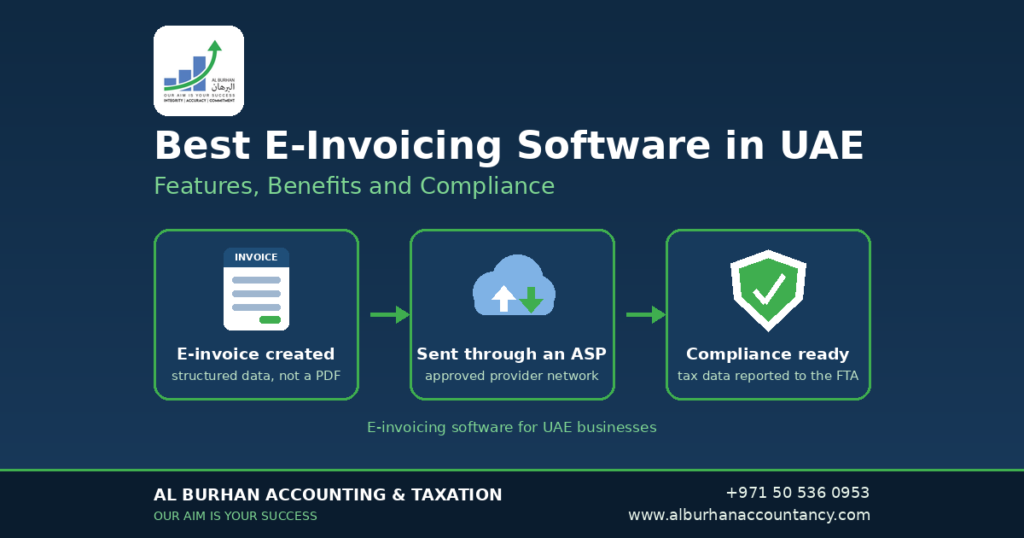
E-invoicing software is the tool that creates your invoices as structured data, checks them, sends them through the approved network and keeps a record of what happened.
In the UAE it works together with an Accredited Service Provider (ASP). Sometimes both come from the same company, and sometimes your accounting system makes the invoice and a separate ASP sends it.
How it differs from a PDF sent by email
A PDF invoice is a picture. A person has to read it and type the numbers into their own system. A compliant e-invoice is a data file, usually XML, that software can read on its own.
The seller’s system creates it, the buyer’s system receives it, and nobody retypes anything.
For the businesses and transactions in scope, an invoice that is only a PDF in an email will stop being a valid tax invoice once your go-live date arrives. The data has to travel through the e-invoicing network.
The software behind this is sometimes called an electronic invoicing system or digital invoicing platform. The names vary, but the job is the same: produce correct invoice data, deliver it, and prove it was delivered.
UAE E-Invoicing Requirements and Compliance Rules
The UAE system is built on Ministerial Decision No. 243 of 2025, which sets out how it works, and Ministerial Decision No. 244 of 2025, which sets the phases. Cabinet Decision No. 106 of 2025 covers the penalties.
Deloitte’s summary of the UAE e-invoicing legislation explains the legal background if you want more detail.
The system applies to business-to-business (B2B) and business-to-government (B2G) transactions. Sales to ordinary consumers are outside the current phase. Whatever software you choose has to support the technical and legal rules below.
UAE E-Invoicing Deadline and Implementation Timeline
Every business has two dates. The first is the date you must appoint an ASP. The second is the date you must start issuing e-invoices. They are not the same, and mixing them up is a common mistake.
| Group | Appoint an ASP by | Mandatory go-live |
| Businesses with annual revenue of AED 50 million or more | 30 October 2026 | 1 January 2027 |
| Businesses with annual revenue below AED 50 million | 31 March 2027 | 1 July 2027 |
| Government entities | 31 March 2027 | 1 October 2027 |
The 30 October 2026 date was originally 31 July 2026. The Ministry of Finance extended the appointment date for large businesses in May 2026. The go-live date did not change.
A pilot and voluntary period opened on 1 July 2026, and businesses that join voluntarily are not fined. Our guide to the UAE e-invoicing mandate and its deadlines explains each group and the extension in more detail.
Accredited Service Providers (ASPs) and E-Invoicing Software
An ASP is a company approved by the Ministry of Finance to connect businesses to the e-invoicing network. It checks your invoices, sends them to your customer’s provider, receives invoices addressed to you, and reports the tax data to the Federal Tax Authority.
You cannot skip this step. Even if your accounting software creates perfect invoice data, you still need an accredited provider to send it.
So when you compare software, you are really comparing a setup: your accounting or ERP system, plus an ASP, plus the connection between them.
To check that a provider is eligible, use the list of accredited providers published by the Ministry of Finance, and ask the provider to confirm its status in writing.
Recent guidance suggests that preliminary approval status has been withdrawn, so check that the provider is fully accredited and not just listed as approved in principle.
Structured Invoice Data and Electronic Invoice Exchange
UAE e-invoices follow a format called PINT AE. It is based on the international Peppol standard, with extra fields for UAE needs.
An invoice carries around 50 mandatory fields, including names, addresses and Tax Registration Numbers, invoice details, item lines, VAT categories and totals.
Invoices are exchanged from system to system over the Peppol network. This is often called the five-corner model: the seller, the seller’s ASP, the buyer’s ASP, the buyer, and the tax authority, which receives the tax data.
Your software does not need to explain this to you, but it needs to handle it without manual steps.
Key Features to Look for in the Best E-Invoicing Software in UAE
A long feature list can be misleading. These are the capabilities that matter most. Ask each vendor to show them working with your own type of invoice, and not only in a sales video.
Automated Electronic Invoice Generation
The software should create the invoice file straight from your sales data, with no retyping. Look for support for tax invoices, credit notes and self-billed invoices, and for the awkward cases too: discounts, advance payments, foreign currency and corrections. If staff still have to adjust invoices by hand, the automation is not doing its job.
UAE E-Invoicing Compliance and Structured Data Support
Check that the software produces the PINT AE format, or works with an ASP that does. It should validate the data before sending, so a missing TRN or a wrong tax category is caught at creation, not after a rejection. Ask how quickly the vendor updates the software when the rules change, because the framework is still developing.
Accounting Software and ERP Integration
Integration is where many projects succeed or fail. Ask whether there is a ready-made connection to your accounting or ERP system, or whether custom work is needed.
A ready-made connection is usually faster and cheaper. Also check how data flows both ways: invoices going out, and invoices received from suppliers coming in.
VAT Records and Financial Reporting Support
E-invoicing does not replace VAT. Your invoices still have to follow the VAT rules, and the same data feeds your VAT return. Good software stores invoices in a way that makes VAT reporting easier, and lets you match invoices to returns and the general ledger.
If you want help checking that your invoice coding and returns agree, our VAT services team can review it before go-live. If you also sell excise goods, the same sales records feed your monthly return, covered in our guide to UAE excise tax return filing, so they should match the invoices you issue.
Real-Time Invoice Tracking and Status Updates
You should be able to see, for every invoice, whether it was created, sent, delivered, accepted or rejected. Rejections need to arrive with a clear reason, so someone can fix the problem quickly. Without status tracking, rejected invoices can sit unnoticed and delay your customer’s payment.
Secure Data Exchange and Access Controls
Invoices contain sensitive commercial information. Ask how data is stored and protected, who can see it, how access is controlled by role, whether there is an audit log of changes, and how backups are handled. Also ask what happens to your data if you leave the provider.
Scalability and Multi-Entity Support
If you have several companies, branches or business lines, check that the software can handle more than one legal entity, each with its own registration details.
Invoices between related companies are business-to-business invoices too, and the same dealings need clear records for the connected persons rules under UAE Corporate Tax. Check pricing and performance as volumes grow, so a busy month does not slow the system or double your bill.
Benefits of E-Invoicing Software for UAE Businesses
Compliance is the main reason to adopt e-invoicing software, but the right system also improves how the business runs.
Faster Invoice Processing and Reduced Manual Work
Structured data moves without retyping. Invoices are checked automatically and delivered faster, so your team spends less time on routine entry and more time on exceptions and analysis.
Improved Accuracy and Fewer Data Entry Errors
Most invoice errors come from people typing numbers. Remove the typing and you remove many of the errors. Built-in validation catches the rest before an invoice goes out.
Better Financial Records and Cash Flow Visibility
When every invoice is stored as structured data, it is easier to search, report and reconcile. You can see what is outstanding more clearly, and chase late payments earlier, which helps cash flow.
Easier Invoice Tracking and Reconciliation
Status tracking shows where each invoice is. Reconciling invoices to payments, to the ledger and to your VAT return becomes quicker, because the data is already in the same structure.
Improved Readiness for Regulatory Compliance
The software helps you meet the rules in a repeatable way, instead of relying on individual staff to remember them. Starting early also gives you time to fix problems before penalties apply.
Under Cabinet Decision No. 106 of 2025, businesses that must use the system can face fixed monthly penalties for failing to implement it on time, and per-invoice penalties for invoices not issued and sent on time. Check the official text for the current amounts, and see our guide to VAT penalties in the UAE for how the wider penalty system works.
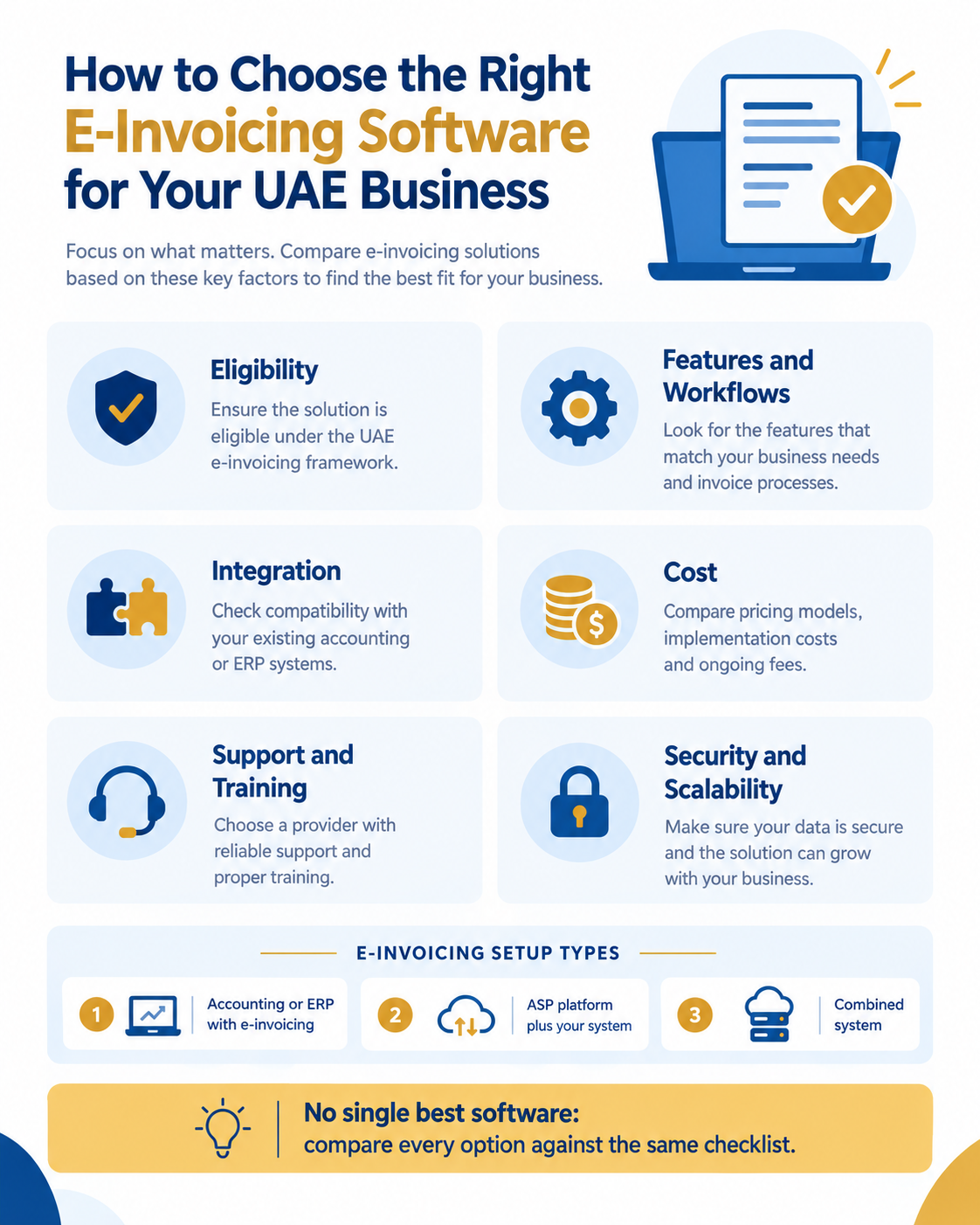
Best E-Invoicing Solutions in UAE: How to Compare Your Options
There is no single best product for every business. A fairer approach is to compare options against the same list of questions. That way the decision rests on evidence you collected, and not on a sales pitch.
It also helps to know the three common setups:
- Accounting or ERP software with e-invoicing built in. The software creates and sends invoices, usually working with an ASP behind the scenes.
- An ASP platform connected to your existing system. You keep your current software and add a connection.
- A combined or replacement system. You move to new software that covers accounting, invoicing and e-invoicing together.
Whichever setup you consider, use this comparison table.
| What to compare | What to check |
| Eligibility | Is the provider on the Ministry of Finance’s list, and fully accredited? Get confirmation in writing. |
| Features and workflows | Does it support tax invoices, credit notes, self-billed invoices, discounts, foreign currency and corrections? |
| Integration | Is there a ready-made connection to your software? How does data flow in both directions? |
| Pricing and implementation cost | What is the full cost over a year, including setup, onboarding and support? |
| Support and training | What are the support hours? Is training included? Who will you speak to? |
| Security and scalability | How is data protected? Can it handle more invoices and more entities? |
Ask two or three providers to run the same test, using a real sample of your invoices, and compare the results side by side.
How to Choose E-Invoicing Software for SMEs in UAE
Small and medium businesses face the same rules as large ones, but with smaller budgets and teams. The aim is a setup that is compliant, simple to run and does not need a full IT department.
Start with your transaction volumes. A business that issues a few dozen invoices a month needs something different from one that issues thousands.
Then look at your existing systems. If your current accounting software already supports e-invoicing, or can be connected easily, that is usually the cheapest route. If it cannot, you may need to upgrade or replace it.
Think about budget as a total cost, not a monthly fee. Add setup, training, support and the staff time involved. Think about reporting needs, such as VAT reports and management reports, and check the software provides them.
And think about growth: a system that suits you now should still work if your volumes double or you add a second company.
Do not confuse the AED 50 million e-invoicing line with other revenue limits, such as the AED 3 million limit for Small Business Relief extended to 2029, which is a Corporate Tax test and does not change your e-invoicing dates.
For businesses with annual revenue below AED 50 million, the ASP appointment deadline is 31 March 2027 and the go-live date is 1 July 2027. That gives you time, but not as much as it seems.
Providers will be busy once larger businesses go live, so starting early gives you more choice and more time to test. Small businesses that sell to larger customers may also be asked to be ready sooner.
E-Invoicing Software Cost in UAE: What Affects Pricing?
Prices vary widely, and they change as the market develops, so this guide does not quote figures. Ask for written quotes and compare the same things. These are the factors that drive the cost:
- Subscription plan: monthly or annual fees, and what each plan includes.
- Invoice volume: many providers price by the number of invoices, or in bundles, so a busy business pays more.
- Integrations: connecting to your accounting or ERP system can be included, or charged as a separate project.
- Implementation: setup, data mapping and testing, which can be a one-off fee or part of the plan.
- Training: whether staff training is included or extra.
- Support: the hours, response times and whether premium support costs more.
- Number of entities or users: extra companies and users can add to the price.
- Software changes: if your current system must be upgraded or replaced, that cost belongs in the budget.
When you compare quotes, work out the total for the first year and for the second year. A low starting price that rises sharply with volume can cost more than a higher, steadier one.
How to Implement E-Invoicing Software in Your Business
Treat this as a project with an owner and a timeline. The core steps are below. KPMG’s guidance on UAE e-invoicing readiness is also worth reading for the project team.
Review Your Current Accounting and Invoicing Processes
Map how an invoice moves through your business today. Who creates it, who approves it, where it is stored, and how credit notes are handled.
Note every place where invoices are created, such as the accounting system, a sales tool or a spreadsheet, because each one will need to connect to the new process.
Check Customer, Supplier, and Invoice Data
E-invoices rely on accurate records. Check names, addresses, TRNs, product descriptions and tax categories. Bad data is the most common cause of rejected invoices. Clean, well-kept accounting and bookkeeping records make this step far easier.
Select an Eligible E-Invoicing Service Provider
Use the Ministry of Finance’s list, confirm full accreditation, and compare at least two or three providers using the table above. Ask for a demonstration with your own invoices and check the contract terms, including what happens if you decide to switch later.
Integrate Your Accounting or ERP System
Connect your system to the provider and map your data fields to the required format. This is the main technical step and often takes longer than planned. Allow time for fixes.
Test Invoice Generation and Exchange
Test the whole journey, not only invoice creation. Send test invoices and credit notes, including discounts, different VAT categories and corrections. Confirm delivery, status updates and tax reporting. Fix every issue before real customers are involved.
Train Employees and Monitor System Performance
Train everyone who touches an invoice. After go-live, check rejected invoices daily, review error patterns weekly and ask the provider to explain anything unusual. Name one person who tells the provider about any change to your registered business details.
Common Mistakes to Avoid When Selecting E-Invoicing Software
Most problems can be avoided with a little care at the start.
- Choosing a solution without checking eligibility. A good demonstration does not prove a provider is accredited. Check the official list and get confirmation in writing.
- Overlooking integration requirements. If the connection to your accounting system is weak, staff end up fixing invoices by hand, and the benefits disappear.
- Ignoring data quality. The best software cannot fix wrong TRNs or inconsistent tax categories. Clean your records first.
- Underestimating implementation time. Integration, testing and training take longer than most people expect, especially for large businesses with only a short gap between the ASP deadline and go-live.
- Failing to train employees. If people go back to emailing PDFs, the system is bypassed. Training and simple controls keep everyone on the new process.
Frequently Asked Questions About E-Invoicing Software UAE
Is E-Invoicing Software Mandatory in the UAE?
The law requires in-scope businesses to issue e-invoices through an accredited provider from their go-live date. In practice, that means you need software that can create and send e-invoices, usually your accounting or ERP system working with an ASP. There is no single mandatory product. The requirement is that the invoices meet the rules.
What Is the Best E-Invoicing Software in UAE?
There is no single best option for every business. The right choice depends on your size, your existing accounting system, your invoice volumes and your budget. Compare options using eligibility, features, integration, cost, support and security, as set out in this guide.
How Do I Verify an Accredited Service Provider in the UAE?
Check the list of accredited providers published by the Ministry of Finance, and ask the provider to confirm its accreditation status in writing. Make sure it is fully accredited and not only approved in principle, and ask what happens to your service if its status changes.
Can E-Invoicing Software Integrate with Existing Accounting Software?
Often yes, either through a ready-made connection or a custom one. Ask your accounting vendor and your ASP what is supported, how data flows in both directions, and what the cost and timeline are. If integration is not possible, you may need to upgrade or replace your accounting system.
Does E-Invoicing Software Replace VAT Returns?
No. E-invoicing changes how invoices are delivered and shares the tax data with the Federal Tax Authority. You still have to file your VAT returns and pay VAT as before. The two are connected, since the same invoice data supports your return, so they should always agree.
How Much Does E-Invoicing Software Cost in UAE?
It varies by provider, plan, invoice volume, integrations, training and support. This guide does not quote prices because they change. Get written quotes from at least two or three providers, and compare the total first-year cost, not only the monthly fee.
Choose the Right E-Invoicing Software for Your UAE Business With Al Burhan Accounting & Taxation
The right e-invoicing software is the one that fits your business and meets the rules. Compare features instead of slogans, confirm that your provider is accredited, check how well the system integrates with your accounting software, and test it before you rely on it.
Large businesses must appoint an ASP by 30 October 2026 and go live on 1 January 2027. Smaller businesses and government entities have later dates, but starting early gives you more choice and less stress.
If you would like help, Al Burhan Accounting and Taxation supports businesses in Dubai with accounting, bookkeeping and tax consultancy. Our accounting systems service can help you review your current setup and prepare it for e-invoicing, alongside your VAT and Corporate Tax obligations.
Book a consultation to find out which deadline applies to you and which setup suits your business.